Painting
Painting a building's communal staircase: price, approval and timing
· 6 min
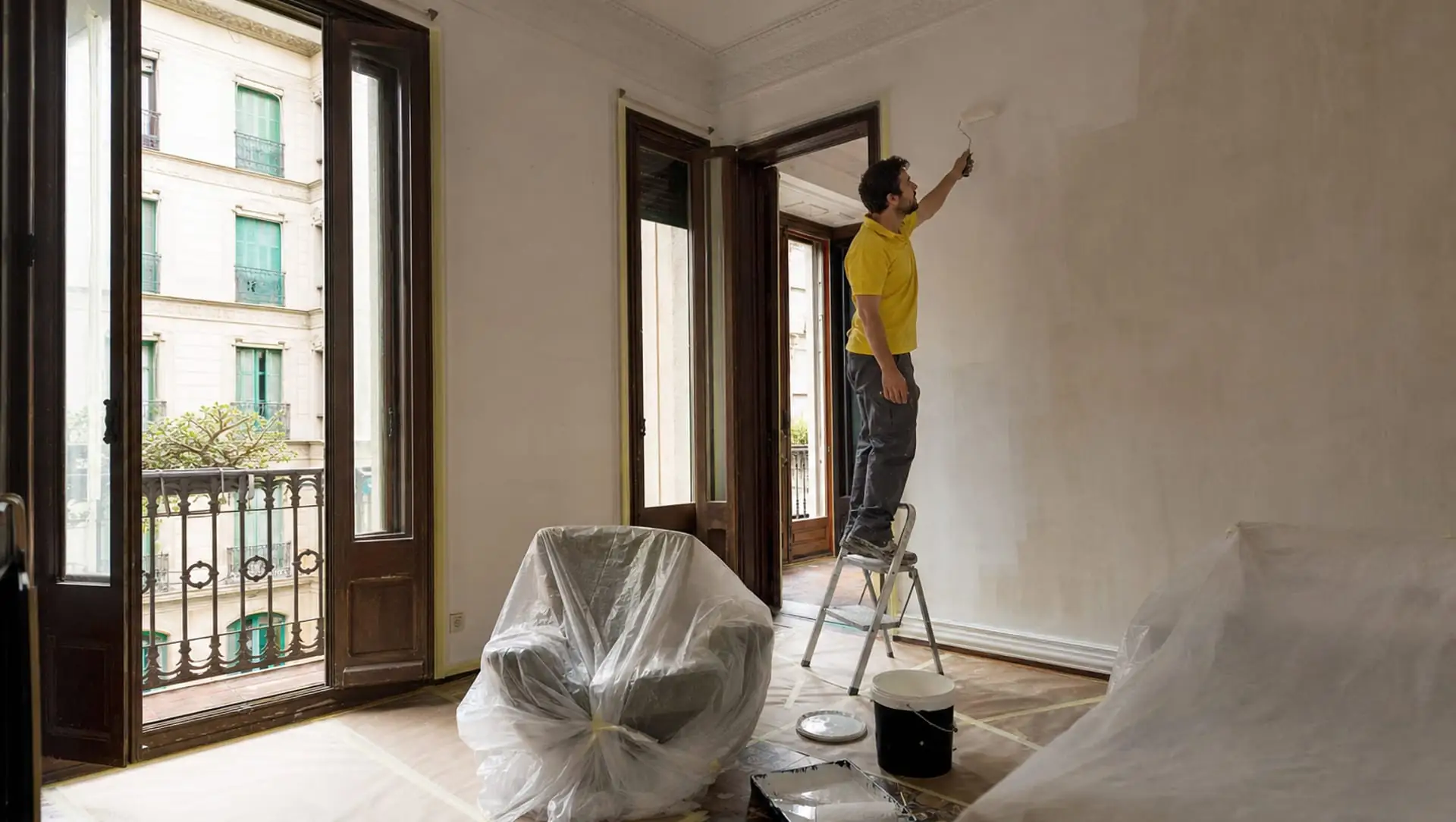
Painting the communal staircase of a residential building in Barcelona has no fixed price per building: it is quoted by the number of floors and the square metres of wall and ceiling, on an indicative base of €8/m²* for two coats. What moves the total most is the height of the stairwell, the condition of the walls and the parts enamelled separately, such as railings, skirting and doors. The work is approved at the owners' meeting, usually as maintenance, and paid from the reserve fund or through a one-off levy (derrama).
How the price is calculated
We measure the real area to be painted: the walls of each flight and landing, ceilings, the underside of the stairs and the entrance hall. The per-square-metre price is applied to that measurement, and then the items that are not measured in metres of wall are added.
| Item | Indicative price |
|---|---|
| Walls and ceilings, two coats | from €8/m²* |
| Complete communal staircase | by number of floors* |
| Railings, skirting and doors | by metres and pieces* |
| Repairing cracks and flaking | by condition* |
*Indicative prices. The final amount is provided in writing, itemised, after visiting and measuring the staircase.
What makes a staircase more expensive
- Stairwell height. In Eixample or Sant Antoni buildings the landing ceilings are high and the central well is deep; painting the walls facing the well needs scaffolding or a platform and more hours.
- Railings. A wrought-iron railing with worked balusters is sanded, treated for rust and enamelled piece by piece. It is one of the most time-consuming items.
- Skirting. Many entrance halls have a dado in enamel or a different colour to withstand knocks; it is painted separately, with a different paint.
- Doors and joinery. Doors to the meter room, the roof terrace or the lift, if included, are quoted per piece.
- Signage and numbering. Re-lettering floors, doors or signs is a small extra item, but it is best decided beforehand.
- Wall condition. Damp, cracks, loose plaster or old paint lifting off all need preparation before painting, and that costs more than the paint itself.
The owners' meeting agreement
The staircase is a common element, so the decision belongs to the community of owners, not to one neighbour alone. In Catalonia, buildings divided into flats are regulated by the Catalan Civil Code, and maintenance and upkeep works are usually approved by a simple majority at the owners' meeting. If, beyond painting, materials change, new elements are added or the look of the entrance hall is transformed, the majority required may differ. Your property manager will tell you what applies in your case and how it should be recorded in the minutes.
A sequence that usually works:
- Ask for two or three written quotes with the same items, so you can genuinely compare them.
- Choose colours and finishes before the meeting, with a sample on a landing if there are doubts.
- Approve the quote, the cost split and the dates at the meeting.
- Pay from the reserve fund or through a levy based on each flat's share coefficient, unless the statutes say otherwise.
- Let residents know with notices in the entrance hall a week before work starts.
Working with residents in the building
People come and go on a staircase all day, with pushchairs, bikes and shopping. So the work goes section by section, top to bottom, and the way through is never blocked. Before painting, steps, handrails, the lift, letterboxes and door entry panels are protected. Every evening the staircase is left clean and usable, with no buckets or ladders in the way.
- Working hours within the building statutes and the noise regulations; sanding and scraping are concentrated in the middle of the day.
- Wet-paint signs on each flight, showing the time from which surfaces can be touched.
- Railings done in halves or by sections, so there is always a dry handrail to hold.
- A single point of contact for the community: the president or the property manager deals with one person from our team.
Timing, smells and drying
| Staircase | Indicative duration |
|---|---|
| Ground floor plus 3 floors | 4–6 working days* |
| Ground floor plus 5 to 6 floors | 7–10 working days* |
| With a wrought-iron railing to enamel | adds 2–4 days* |
*Indicative timings, not counting major wall repairs or days lost waiting for damp to dry.
For walls and ceilings we use low-odour, water-based emulsion, which is touch-dry in a few hours and takes a second coat the same day or the next. The smell is mild and clears in a day or two if the stairwell is ventilated, which is easy in buildings with a light well or skylight. Enamels on railings and doors take longer to harden: it is best not to lean on them until the next day. In winter or with high humidity, drying times are longer.
Before painting: what to check
If the staircase has damp patches, salt deposits low down in the entrance hall or cracks that keep reappearing in the same places, painting over them only hides them for a few months. In ground floors in Gràcia, Sants or Poble-sec, rising damp in the entrance hall is common, and the top flight can show leaks from the roof terrace. The sensible approach is to find the cause and fix it first, or at least have it diagnosed and quoted so the meeting can decide with all the information.
If your building is thinking about painting the staircase, ask us for a visit. We measure, look at railings, skirting and the condition of the walls, and send you a written, itemised quote that the property manager can take to the meeting. We reply within 24 working hours and work across Barcelona, the metropolitan area and the province.
Frequently asked questions
Questions on this topic
There is no fixed price per staircase: it is calculated by the number of floors and the square metres of wall and ceiling, on an indicative base of €8/m²* for two coats. Railings, skirting, doors and signage are quoted separately. The final amount is given in writing after a visit.
In Catalonia, buildings divided into flats are governed by the Catalan Civil Code, and maintenance and upkeep works on common elements are usually approved by a simple majority at the owners' meeting. If the appearance changes significantly or improvements are added, a different majority may apply. Confirm it with the property manager (administrador de fincas).
Usually through a one-off levy (derrama) based on each flat's share coefficient, unless the building's statutes say otherwise or the community has enough in its reserve fund. The property manager prepares the split once the quote is approved.
Yes. The work goes section by section, a clear way through is always left and freshly painted areas are signposted. Enamelled railings are the most delicate part: signs tell residents how long to wait before touching them.
With water-based emulsion the smell is mild and goes within a day or two with ventilation. It is touch-dry in a few hours; the enamel on railings and doors takes longer and is best left untouched until the next day.