Plumbing
Lead pipes in old Barcelona flats: how to tell and how to replace them
· 6 min
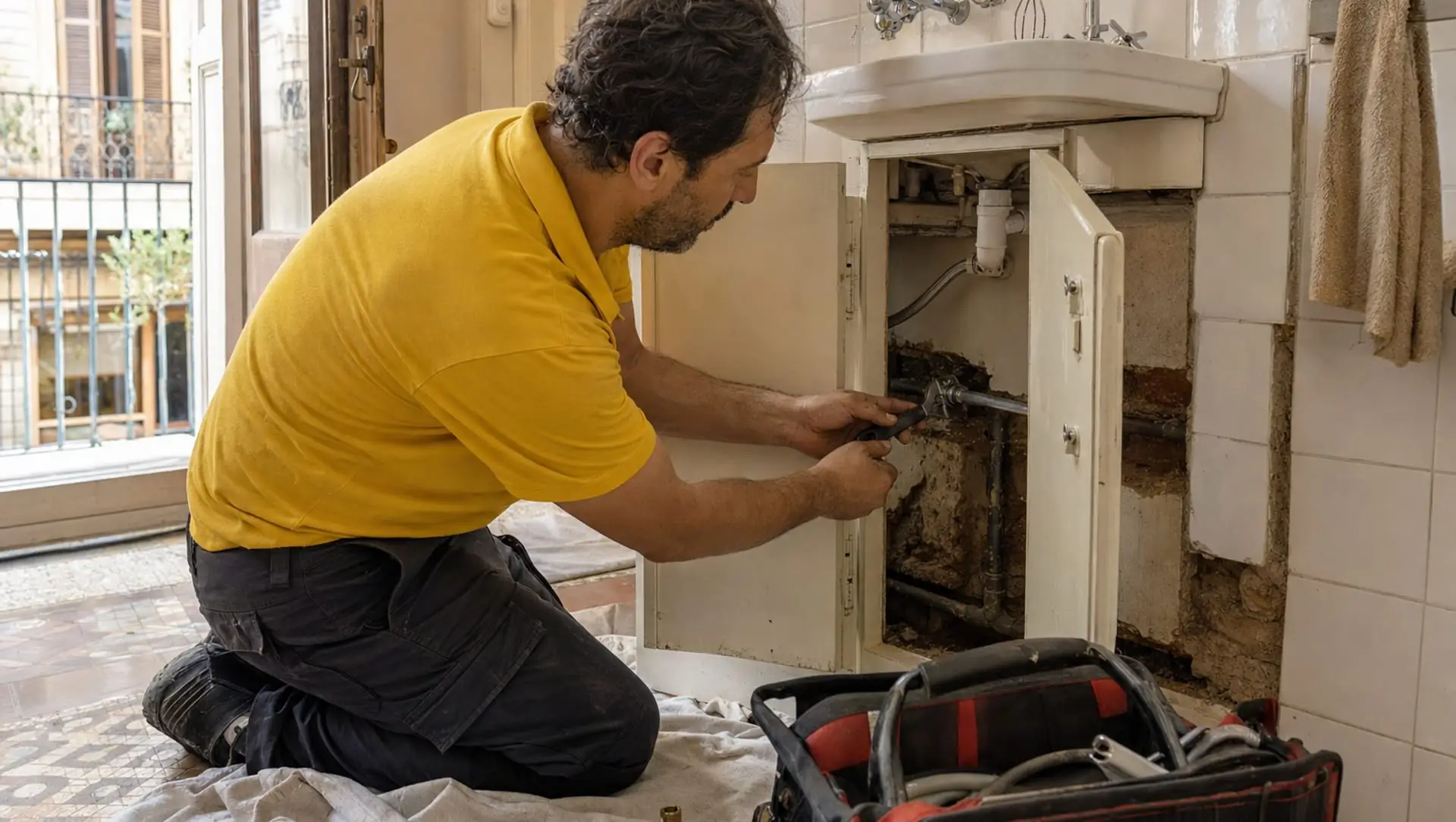
If your flat is in an old Barcelona building and nobody has changed the plumbing in decades, it may still have sections of lead. You can recognise them because they are dull grey, soft pipes that a magnet will not stick to, running in smooth bends with bulging joints. Replacing them is recommended: pipes inside the flat are paid for by the owner, and the building's risers by the community of owners. Renewing a bathroom's plumbing starts at €900*, and a full replacement depends mainly on the distance to the meter.
How to tell if you have lead pipes
Look for exposed pipes: next to the meter, under the kitchen sink, behind the toilet or in the enclosed gallery. These are the signs of lead:
- Dull grey colour, no shine. Scratch it with a key and bright, silvery metal shows underneath.
- It is soft: it scratches easily and often has dents.
- A magnet will not stick. Galvanised iron, also common in old buildings, does attract a magnet.
- It runs in smooth curves rather than angled elbows, because it was bent on site.
- Joints bulge, like a blob of solder, instead of being threaded or press-fit fittings.
- Tapped with something metal, it sounds dull, with no ring.
Copper is reddish or brown, and plastic or multilayer pipes are light and white, grey or coloured. If a visible section is lead, it most likely carries on inside the wall. If in doubt, a plumber can confirm it on a visit.
Why they should be replaced
Lead can leach into water, especially when it has been standing in the pipe for hours, and it is a toxic metal whose exposure is best avoided, particularly for young children and pregnant women. Spain's drinking-water regulation, Royal Decree 3/2023, progressively tightens the limits for lead in tap water, and replacing lead installations is part of that aim. Besides, these pipes have many decades of use behind them: they lose flow, drip at the joints and do not take partial repairs well.
Until you replace them, a sensible precaution is to run the cold tap for a while before drinking, especially in the morning or after a few days away, and to cook with cold water rather than hot water from the tap. If you want to know the lead level in your water, you can order an analysis from an accredited laboratory, which will tell you how to take the sample.
Who pays: the flat or the community
The general rule is simple: what serves only your flat is yours, and what is common belongs to the community. In practice:
- Inside the flat, from your own stopcock onwards: pipes, supply points and drains are paid for by the owner.
- Risers and the building's general network, from the mains connection to the meters and the columns rising through the staircase or light well: paid for by the community, because they are common elements.
- The section between the meter and your flat, when meters are grouped on the ground floor, is the one that raises most questions. Although it runs through common areas, it is often treated as belonging to each flat; it depends on the statutes and how the building is laid out.
- If you rent, talk to your landlord: the installation is theirs.
Before asking for a quote, ask the property manager who owns each section in your building. If the community plans to replace the risers, it is best to coordinate so both jobs are done back to back and the building's water is cut only once.
What replacing them involves, step by step
- Visit and route: we locate the stopcock, the meter and the pipe run, and assess whether the pipes go concealed or on the surface.
- Coordination with the community if the building's water has to be cut or work is needed in the meter room.
- Water shut-off and removal or disconnection of the lead sections.
- New installation, usually in multilayer, cross-linked polyethylene (PEX) or copper, with a main stopcock and an isolating valve for each wet room.
- Pressure test before the chases are closed, to make sure there are no leaks.
- Closing the chases and making good tiling or paint where the wall was opened.
The cheapest time to replace them is during a bathroom or kitchen renovation, with the walls already open. If no work is planned, they can sometimes run on the surface or behind skirting to open up less. In buildings from before 2002 the soil stacks may be asbestos fibre cement: they must not be cut, and if they need removing a firm registered in the RERA does it.
What it costs
| Work | Indicative price |
|---|---|
| Call-out + first hour | from €60* |
| Bathroom plumbing renewal (supply points and drains, no sanitaryware) | from €900* |
| Bathroom renovation, turnkey | from €3,500* |
| Kitchen renovation, turnkey | from €4,500* |
| Full renovation of a home (materials not included) | from €300/m²* |
| Replacing the whole flat's pipework | depending on the route* |
*Indicative prices. We confirm the final figure in writing, item by item, after the visit.
What changes the price
- The distance between the meter and the flat, especially if the meters are on the ground floor of a building with no lift.
- The number of water points: bathrooms, kitchen and a gallery with a washing machine.
- Whether the pipe is concealed or exposed.
- The finishes to be made good, such as old wall tiling or a hydraulic tile floor you do not want to lose.
- The water shut-off times agreed with the community.
If you suspect there is lead in your home, send us a photo of the pipes next to the meter or under the sink. We reply within 24 working hours, come to see them and send you a written quote, with each section and the finishes as separate items. We work across Barcelona and the metropolitan area, from Ciutat Vella to Sant Andreu and from L'Hospitalet to Badalona.
Frequently asked questions
Questions on this topic
Look for a visible section next to the meter or under the kitchen sink. Lead is dull grey and soft, a key scratches it to reveal silvery metal, a magnet will not stick and it runs in smooth bends with bulging joints. If in doubt, a plumber can confirm it on a visit.
Pipes that serve only your flat are paid for by the owner; the risers and the building's general network by the community of owners. The section between centralised meters and the flat depends on the building's statutes and layout, so confirm it with the property manager.
Spain's drinking-water regulation, Royal Decree 3/2023, progressively tightens the limits for lead and pushes towards replacing these installations. Check the specific obligations with your property manager or the water supplier; either way, replacing them is the recommended course.
Renewing a bathroom's plumbing, with supply points and drains but no sanitaryware, starts at €900*. Replacing the whole installation depends on the length of pipe to the meter, the number of water points and the finishes to be redone, and is quoted after a visit.
If they are concealed, yes: wall chases are cut, the new pipe is installed, a pressure test is carried out and the chases are closed. If no renovation is planned, the pipes can sometimes be run on the surface to open up less. The cheapest moment is during a bathroom or kitchen renovation.