Renovations
Renovating an old Eixample flat: what to keep and what to replace
· 7 min
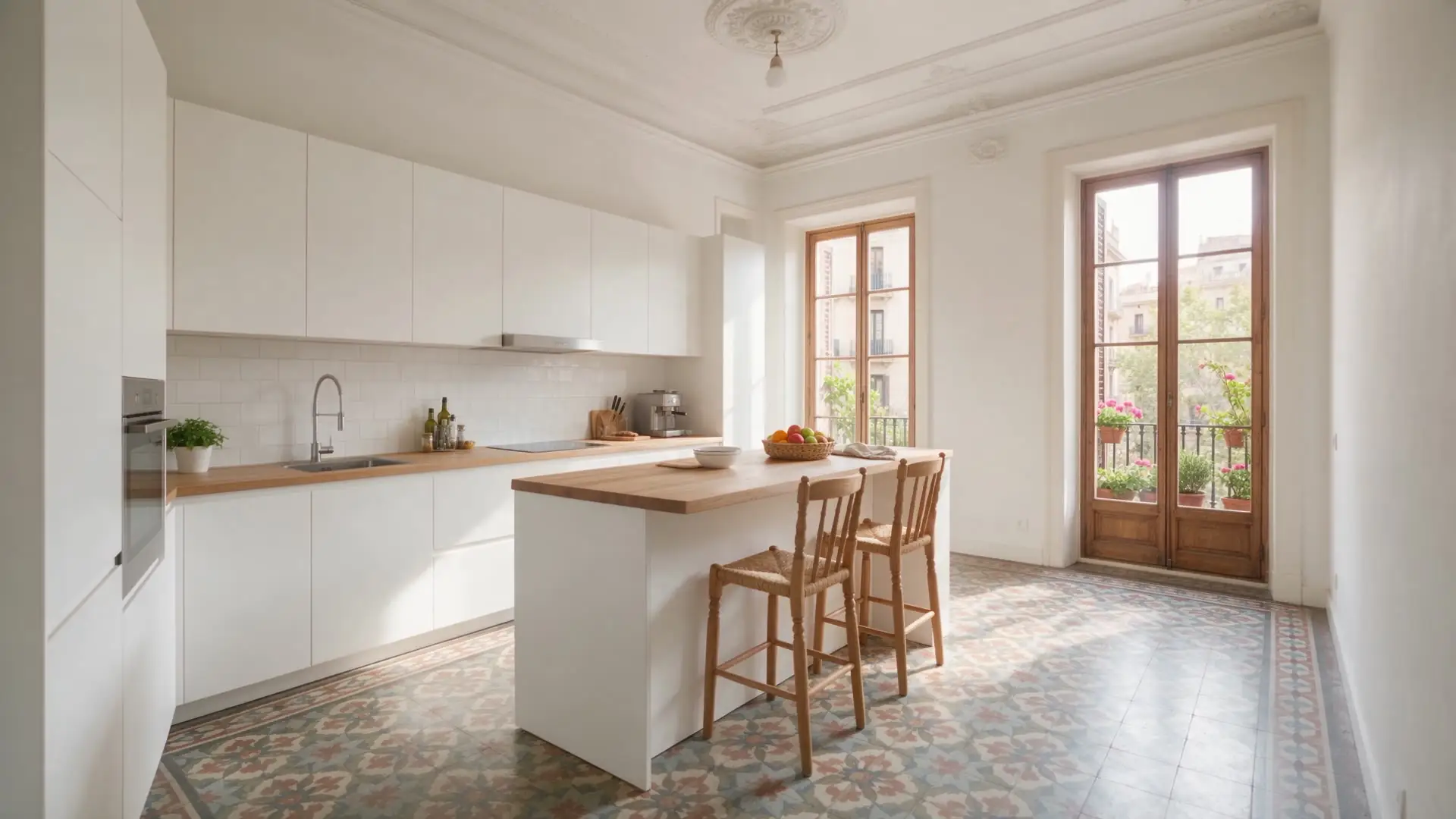
In an old Eixample flat it is usually worth keeping the hydraulic or mosaic tile floors, the plaster cornices, the timber doors and windows and, if they are sound, the ceiling beams and vaults. What almost always needs replacing is what you cannot see: plumbing, often with sections of lead, drains, wiring and the consumer unit. A full renovation starts at €300/m²*, materials not included, and the final price depends mainly on the state of those services and how much of the original you want to recover. Before you start, check whether the building is listed, because it changes the permit route.
What a typical Eixample flat looks like
Most Eixample buildings went up between the late 19th century and the first decades of the 20th, and the same type of flat is found in Gràcia, Sant Antoni and Poble-sec. The plan is usually long and narrow: the main rooms face the street, the bedrooms sit in the middle around one or two light wells (patios de luces), and the kitchen, dining room and enclosed gallery face the inner courtyard of the block, all linked by a long corridor. Almost every decision follows from that:
- The middle rooms get light and air only from the light well.
- Bathrooms were often added later, in interior spaces with no window or a small window onto the light well.
- Ceilings are high, often above three metres, which leaves room to run services through a suspended ceiling in the corridor and bathrooms without losing the sense of height.
- Load-bearing walls are solid brick, and floors are usually timber or iron beams with small brick vaults between them, the so-called Catalan vaults.
What is worth keeping
These features cannot be bought ready-made and they give the flat much of its value. Restoring them takes skilled hours, so it pays to decide room by room:
- Hydraulic and mosaic tile floors. Cement hydraulic tiles and small-piece mosaics are hard to reproduce. Missing tiles are salvaged from another room or reproduced to order, and the whole floor is polished.
- Plaster cornices, mouldings and ceiling roses. They are cleaned, lost sections are recast from moulds taken from the cornice itself, and then painted.
- Interior timber doors, often with etched glass or glazed fanlights. They are stripped, adjusted and fitted with new ironmongery.
- External joinery and inner shutters. An old timber window can be restored and, if the profile allows, upgraded with double glazing. If it is replaced, the façade may have rules on colour and pane layout, especially in listed buildings.
- Beams and vaults. If removing the old ceiling reveals beams and brick vaults in good condition, they can be left exposed, but a qualified technician must first inspect the beams, particularly where they bear on the walls.
What almost always needs replacing
- Plumbing. Lead or galvanised iron pipes still turn up in these buildings. With the walls open, this is the moment to replace them back to the meter.
- Drains. Old ones tend to have little fall and narrow diameters. The building's soil stack is a common element, so replacing it is coordinated with the community of owners.
- Wiring. Circuits without earthing, old cables or improvised joints are not unusual. A full rewire is done by an authorised electrician and ends with their certificate.
- Consumer unit, with RCD and circuit-breaker protection for each circuit.
- Kitchen and bathrooms, which are almost never where or how you want them.
Light wells and interior bathrooms
The light well is the only source of light and ventilation for many rooms, and it is a common element: closing a window onto it, hanging an outdoor unit or running a duct through it needs the community's agreement and, depending on the case, the Ajuntament's. An interior bathroom with no window needs mechanical extraction, with a fan ducted to a light well, an existing ventilation duct or the roof if the community allows it. Without it, steam ends up as mould on the ceiling and in the grout.
A renovation is also the chance to rework the layout: moving the bathroom closer to the soil stack, opening the kitchen to the dining room or gaining a bedroom. First, a technician must confirm which walls are load-bearing: in old buildings some partitions have started carrying load over the years.
Listed buildings and heritage protection
Many Eixample buildings appear in Barcelona's architectural heritage catalogue, with different levels of protection. Protection usually concerns the façade, the entrance hall and the staircase, and in some buildings interior elements too. If your building is listed, works that would be simple elsewhere may need a prior report, a technical project or conditions on materials and colours. You can check the listing with the Ajuntament de Barcelona or ask the property manager; we help you check it during the visit.
For interior works that do not touch the structure, façade or common elements, the usual route is a comunicado de obras to the Ajuntament. If you touch the structure or the façade, you need a technical project and a licence, and there may be a municipal fee and the construction tax (ICIO). Confirm the exact procedure with the Ajuntament before starting.
Indicative prices
| Work | Indicative price |
|---|---|
| Full renovation of a home (materials not included) | from €300/m²* |
| Full rewiring | from €45/m²* |
| Consumer unit replacement | from €350* |
| Bathroom plumbing renewal | from €900* |
| Bathroom renovation, turnkey | from €3,500* |
| Kitchen renovation, turnkey | from €4,500* |
| Painting walls and ceilings | from €8/m²* |
| Restoring hydraulic tiles or cornices | depending on condition* |
*Indicative prices. A full renovation of a 90 m² flat starts at about €27,000* in labour, materials not included. You get the final figure in writing, item by item, after we have seen the flat.
Where to start
- Visit and inspection openings: we open small areas of ceiling, floor or wall to see beams, pipes and cables.
- Photo inventory of what is being kept and protection of those features before demolition.
- Written quote with separate items: demolition, services, restoration, building work and finishes.
- Municipal paperwork and notice to the community of owners.
- Selective demolition, services, building work, restoration and finishes, in that order.
- If the building predates 2002 and fibre cement turns up, that part stops and a firm registered in the RERA asbestos register removes it.
If you have an old flat in the Eixample, Gràcia or Sant Antoni and are not sure what is worth saving, send us a few photos of the floors, ceilings and doors. We reply within 24 working hours, come to see it and send you a written quote, with what is kept and what is replaced as separate items.
Frequently asked questions
Questions on this topic
Yes, in most cases. It is protected during the works, broken tiles are replaced with tiles salvaged from another room or with reproductions, and the floor is polished and sealed at the end. If one area is badly damaged or services have to run through it, sometimes only that part is redone.
A full renovation starts at €300/m²*, materials not included. What moves the price most is the state of the plumbing and wiring, how many original features are restored and whether the building is listed. The final figure is given in writing, item by item, after the visit.
If the work is interior and does not touch the structure, the façade or common elements, a comunicado de obras (works notification) to the Ajuntament is usually enough. If it touches the structure or façade, or the building is listed with protection of those elements, you need a technical project and a licence. Confirm the procedure with the Ajuntament before starting.
With an extractor fan ducted to a light well, to an existing ventilation duct or to the roof, depending on what the building and the community of owners allow. It is best wired to switch on with the light or with a humidity sensor.
You can check with the Ajuntament de Barcelona, which keeps the city's architectural heritage catalogue, or ask the building's property manager (administrador de fincas). Each building's entry states its protection level and which elements are protected.