Solar panels
Battery for solar panels: when it is worth it and what it costs
· 5 min
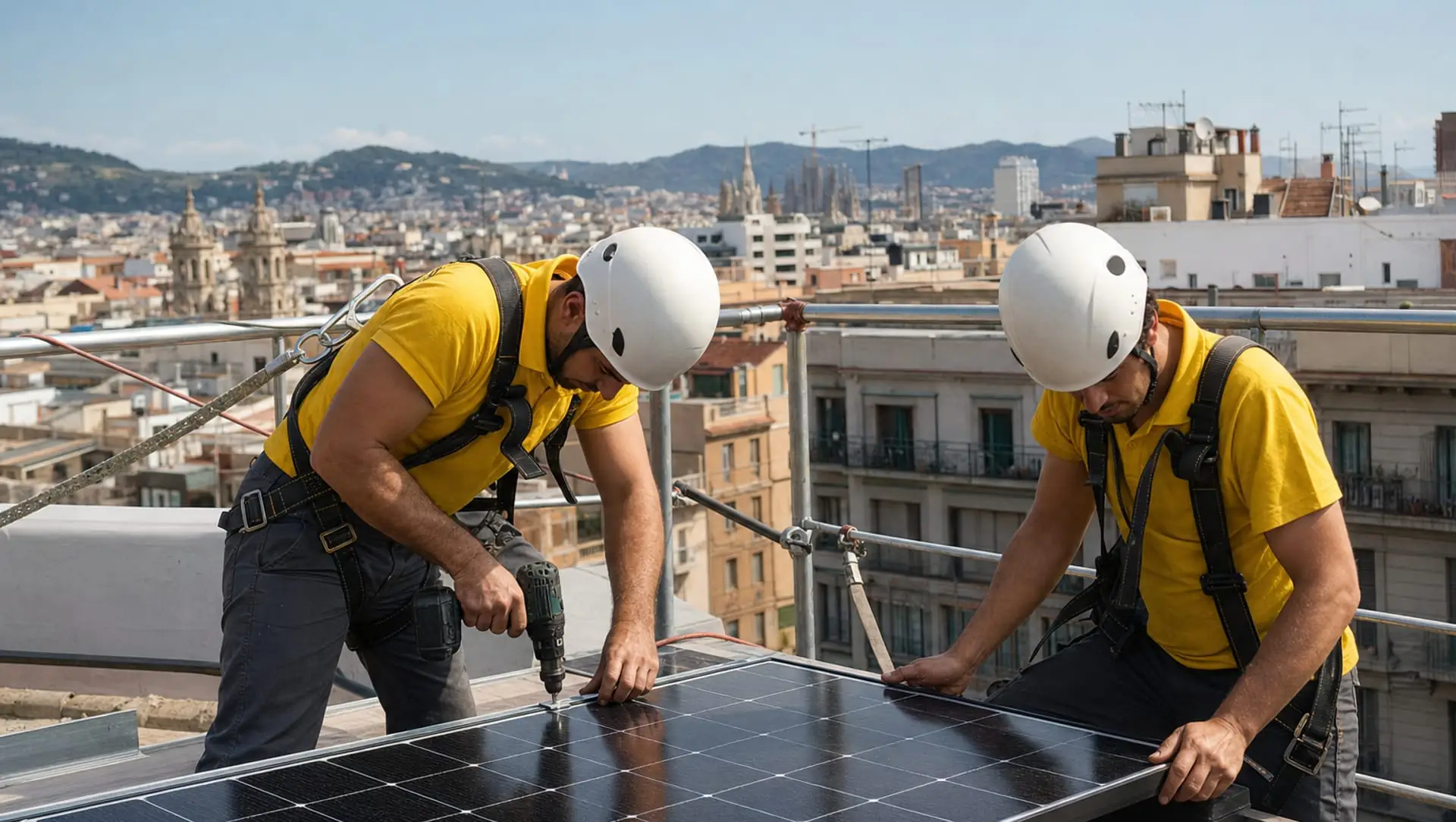
A battery for solar panels costs, as a guide, from €3,000* depending on capacity, and it is worth it mainly if you use much of your energy at night, if your supplier pays little for surplus energy and if your panels produce more than you use by day. If you use almost everything during daylight hours, surplus compensation is usually enough and a battery takes a long time to pay for itself. The decision should be made with your consumption curve, not by gut feeling.
Indicative prices
| System | Indicative price |
|---|---|
| Home self-consumption, about 3 kWp, no battery | from €4,500* |
| Battery for self-consumption, depending on capacity | from €3,000* |
| Self-consumption with battery, installed together | from €7,500* |
| Panel maintenance and cleaning, per visit | from €120* |
*Indicative prices for standard installations in Barcelona. The amount depends on capacity, the inverter and where the battery goes. Possible grants are not deducted. We confirm it in writing after the survey.
When a battery pays off
- You use a lot in the evening and at night: electric cooking, a water heater, heating or cooling, or a family that gets home after dark.
- Your supplier pays little for surplus, so storing energy is worth more than exporting it.
- Your panels clearly produce more than you use at midday and you currently export a lot of energy.
- You want backup during outages and you design the system for it.
When it usually does not
- You work from home or the house is busy by day, so you use almost all the output as it is produced.
- The system is small and generates little surplus to store.
- Your supplier offers reasonable compensation or a bill-credit storage scheme that suits you.
- You do not have a suitable place for the battery at home.
Working from home cuts both ways: if you are in at midday, you use the panels' output directly and need less battery; if your heavy use comes in the evening, the battery moves that midday surplus to the hours when you use it.
Capacity and consumption: how to size it
A battery that is too large sits half-charged most of the year and lengthens the payback; one that is too small runs flat before dinner. To get it right:
- Look at how much energy you export now, or will export, on a typical spring day and a typical winter day.
- Work out how much you use from sunset until the panels start producing again.
- A sensible usable capacity lies between those two figures; above that, it rarely fills up.
- Look at usable capacity, not just nominal capacity, and at discharge power if you want to run several appliances at once.
Adding the battery later
If you are still unsure, a practical option is to install the panels now with a hybrid inverter, ready to take a battery, and decide later with real production and consumption data from the monitoring. If you already have a conventional inverter, a battery can be added with its own connection equipment, although it normally costs more than planning for it from the start.
Where the battery goes in a flat or a house
Home batteries are usually wall-mounted or floor-standing, close to the inverter and the consumer unit. A house in Sant Cugat or in Horta often has a garage or storeroom; in a flat in Sants or Poblenou space is tighter. The manufacturer sets the installation conditions, such as temperature range, ventilation and clearances, and places exposed to the sun or next to heat sources are best avoided. You also need to allow for the weight of the unit and make sure the wall can carry it.
Lifespan and warranty
How long a battery lasts depends on its chemistry, how many charge and discharge cycles it does per year and the temperature it works at. Manufacturers guarantee a number of years or cycles with a minimum remaining capacity, and those terms vary from one unit to another. Read them before buying and factor them into the payback calculation.
A battery is not the same as backup in a power cut
This is the most common misunderstanding. For safety, a grid-connected system switches off when the grid goes down, and the battery with it, unless the inverter has a backup function and the installation has been designed with a separate circuit for the loads you want to keep, such as the fridge, lights or router. If backup matters to you, say so from the start: it changes the inverter, the consumer unit and the quote.
If you want to know whether a battery makes sense for you, send us your bills or consumption curve and, if you already have panels, a screenshot of the monitoring. We reply within 24 working hours and give you a written comparison of installing with and without a battery, with an itemised quote.
Frequently asked questions
Questions on this topic
A home self-consumption battery costs, as a guide, from €3,000*, depending on capacity and equipment. If the inverter also needs replacing with a hybrid one, that is quoted separately. The exact amount is confirmed in writing after the survey.
It usually makes sense if you use a lot of energy at night, if your supplier's surplus compensation is low and if your panels produce more than you use during the day. If you use almost everything during daylight hours, surplus compensation is usually enough.
Yes. The simplest route is to install a battery-ready hybrid inverter from the start. If you already have a conventional inverter, a battery can be added with its own equipment, although it usually costs a little more.
Not necessarily. Most grid-connected systems switch off when the grid goes down, for safety. For backup, the inverter needs a backup function and the installation must be designed with the circuits you want to keep running.
It depends on the chemistry, the number of cycles and the operating conditions. Manufacturers guarantee a number of years or cycles with a minimum capacity; check that warranty before buying.