Solar panels
Solar panels for a residents' association: vote, sharing and costs
· 5 min
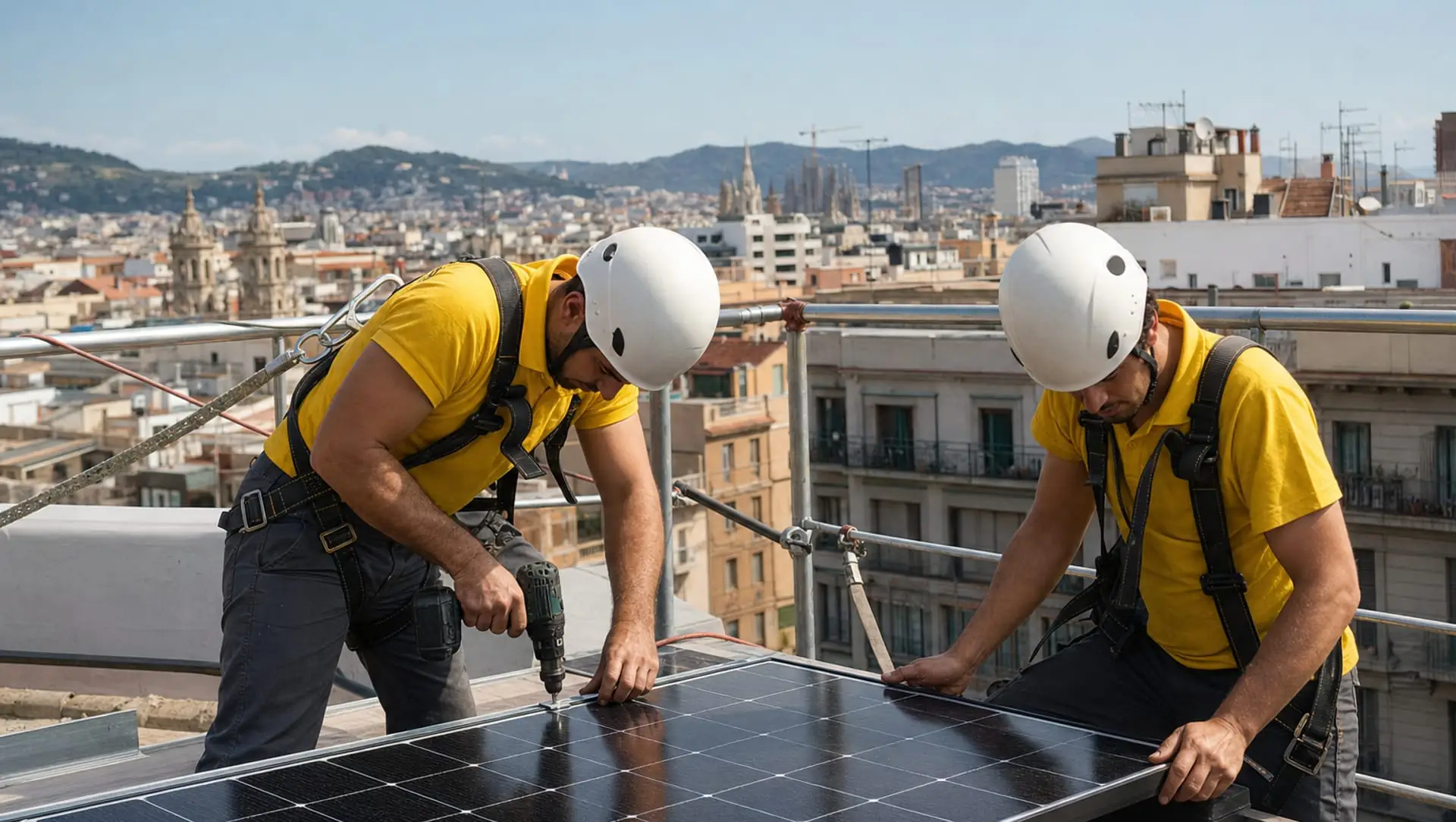
Yes, a residents' association can install solar panels on the roof and share the energy among the owners who take part, through collective self-consumption. It needs an agreement at the owners' meeting, an output-sharing arrangement by coefficients signed by the participants, and a roof survey. The cost is set after survey*, because it depends on the size of the roof, the number of neighbours who join and the cable run to the meters.
How collective self-consumption works
Royal Decree 244/2019 allows several consumers to share one installation. In a building, the panels go on the common roof and each participating neighbour receives the share of output assigned by the sharing coefficients. Everyone keeps their own electricity contract and supplier, and their bill shows the self-consumed energy and, where applicable, surplus compensation. The installation can also supply common consumption such as the lift or the stairwell lighting.
Sharing coefficients
- Fixed sharing: each participant always receives the same percentage, for example according to what they contributed to the investment.
- Hourly variable sharing: the percentage changes by time slot, so more morning energy can go to whoever uses it by day.
- The sharing agreement is signed by all participants and notified to the distribution company through the suppliers.
- The coefficients can be changed later, under the conditions and deadlines set by the rules in force.
The fairest split is not always the simplest. A neighbour who works from home makes much better use of midday energy than one who is out all day. With each participant's consumption, a split can be proposed that makes sense for everyone.
What is voted at the meeting
Spain's Horizontal Property Act sets a reduced majority for installing common renewable energy systems: one third of the owners who also represent one third of the participation shares. In Catalonia, horizontal property is also regulated by the Catalan Civil Code, which has its own majorities, so your property administrator should confirm which applies to your building before calling the meeting. If a single owner wants to install panels for their own flat on the shared roof, they still need the association's agreement, because it involves using a common element.
The minutes should record who takes part, how the cost is split, what happens if a neighbour joins later, who handles maintenance and what happens if the roof needs work in the future and the panels have to be removed.
Eixample roof terraces and older buildings
Many buildings in the Eixample, Gràcia or Sant Antoni have walkable roof terraces (terrats), with washing lines, stairwell huts and masonry parapets. They are good surfaces for panels, but a few points need checking before deciding:
- The state of the waterproofing: if the terrace leaks, the sensible order is to fix it before covering it with structures.
- The load on the floor slab: in older buildings we check how the weight of the structure and ballast is spread.
- Shade from stairwell huts, chimneys, aerials and taller neighbouring buildings.
- How the neighbours want to keep using the terrace.
- The cable run to the meter room and space for the inverters.
- If the building is listed, any visual-integration conditions the Ajuntament may set.
Indicative costs
| Item | Indicative price |
|---|---|
| Collective self-consumption for a residents' association | after survey* |
| Self-consumption for a detached house, about 3 kWp, no battery | from €4,500* |
| Panel maintenance and cleaning, per visit, home installation | from €120* |
*Indicative prices. For a residents' association the amount depends on the usable area, the power, the participants and the cable run, and is given in writing after the survey. Possible grants are not deducted: check those currently available for associations with the Ajuntament and the Generalitat (Catalan government).
How to take it to the meeting
- A neighbour or the chair asks the administrator to put the item on the agenda.
- Bills from interested neighbours are collected and, if possible, their consumption curves.
- A roof survey is commissioned with estimated output, a sharing proposal and an itemised quote.
- At the meeting the survey is presented, the installation is voted on and the participants and payment method are approved.
- Participants sign the sharing agreement, and the works notification and legalisation are processed.
- After installation, each neighbour checks the self-consumed energy and compensation on their bill.
If your residents' association is considering panels, tell us the address and how many neighbours might be interested. We reply within 24 working hours, inspect the roof and prepare a study with the estimated output and a written, itemised quote that you can present at the meeting.
Frequently asked questions
Questions on this topic
Spain's Horizontal Property Act sets a reduced majority, one third of the owners representing one third of the shares, for installing common renewable energy systems. In Catalonia, horizontal property is also governed by the Catalan Civil Code, which has its own rules. Confirm the applicable majority with your property administrator before calling the meeting.
In general, neighbours who do not join neither bear the cost of the installation nor receive energy, although the exact terms depend on the agreement and the applicable rules. If someone wants to join later, they would normally pay their corresponding share. Set this out in the minutes.
Only with the agreement of the residents' association, because the roof is a common element. The meeting must authorise the use of that space and set the conditions. Nothing should be installed without that agreement.
The price is set after survey*, once the roof, the participating neighbours' consumption and the cable run to the meters have been analysed. Maintenance for a home installation starts at €120* per visit; for a shared installation it is quoted according to size.
They are the percentages that set what share of the output goes to each participating neighbour. They are fixed in an agreement signed by everyone and notified to the distribution company through the electricity suppliers. They can be fixed or vary by hour.