Solar panels
Solar panels in Barcelona: 2026 price, incentives and payback
· 6 min
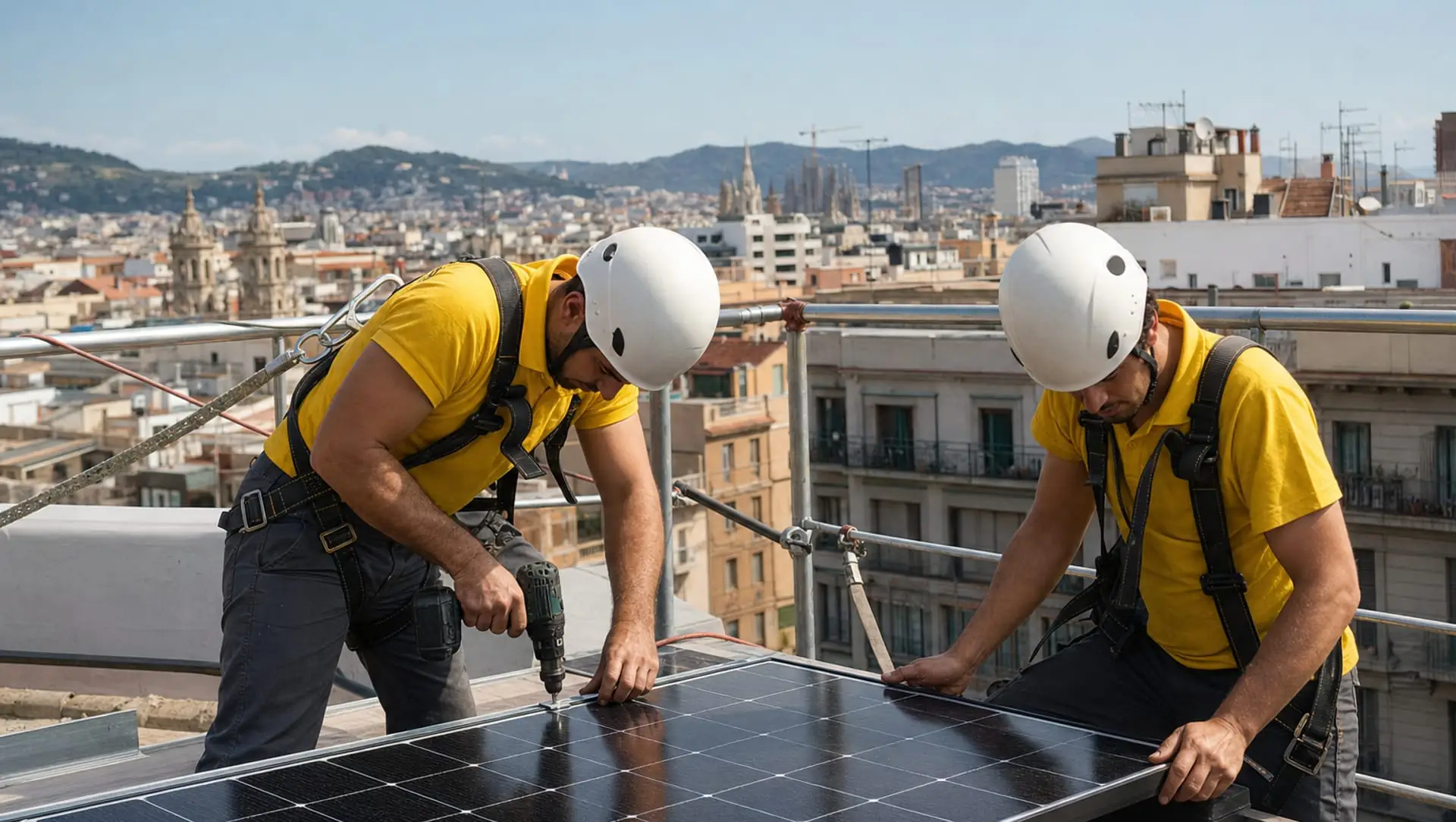
In Barcelona, a home self-consumption system of about 3 kWp without a battery costs, as a guide, from €4,500*, with panels, inverter, mounting structure, wiring, installation and legalisation included. The right size comes from your annual consumption in kWh, the share you use during daylight hours and the usable roof area. Incentives and tax discounts exist, but they change every year, so it makes sense to calculate the payback without them and treat them as a bonus if they come through.
Indicative self-consumption prices in Barcelona
| System | Indicative price |
|---|---|
| Home self-consumption, about 3 kWp, no battery | from €4,500* |
| Battery for self-consumption, depending on capacity | from €3,000* |
| Self-consumption for residents' associations | after survey* |
| Panel maintenance and cleaning, per visit | from €120* |
*Indicative prices for standard installations in Barcelona. The final amount depends on the roof, the cable run to the consumer unit and the equipment chosen. Possible grants and tax deductions are not deducted. We confirm it in writing, item by item, after the survey.
What the price includes
- Initial survey: consumption, orientation, shading throughout the day and the condition of the roof.
- Photovoltaic panels and their structure, flush-mounted on a pitched roof or tilted on a flat roof terrace.
- Inverter, electrical protection and wiring to the home's consumer unit.
- Installation, commissioning and production monitoring from your phone.
- Legalisation: installation certificate, self-consumption registration and the paperwork to sign up for surplus compensation.
What usually pushes the price up: a roof whose waterproofing is in poor condition and should be fixed first, a long cable run from the roof to the consumer unit, awkward fixings on traditional clay tiles, or the need for a crane or scaffolding to lift the material.
How the system is sized from your bill
The starting point is your annual consumption in kWh, shown on your bills or in your distribution company's customer area. With that figure and your daily routine we estimate how much you will use at the time the panels are producing. A family that works from home or runs the washing machine and dishwasher at midday makes far better use of the output than a house that stays empty until seven in the evening.
- Gather the bills for a full year, or the hourly consumption curve if your distribution company provides it.
- Look at how much you use by day and how much at night.
- Check the shade-free area: chimneys, aerials, neighbouring buildings and trees all count.
- For a first idea of output at your address, the European Commission's free PVGIS tool gives an estimate by orientation and tilt.
- Size the system mainly to cover daytime consumption; oversizing just to export surplus rarely pays.
Detached house or flat: two different situations
In a house in Sant Cugat, in the Vallès or in a detached house in Horta, the roof is yours and the system is individual: you decide, the cable run is short and the paperwork is simple. In a flat, the roof is a common element of the building. To install panels you need the agreement of the residents' association, and the usual route is shared (collective) self-consumption for several neighbours or the whole building. We explain this in our guide to solar panels for residents' associations.
Surplus compensation
Self-consumption is regulated by Royal Decree 244/2019. In a grid-connected home system, the energy you do not use at the time goes into the grid and, under the simplified compensation scheme (compensación de excedentes), your supplier deducts it from the energy part of your bill at a price it sets. That deduction does not usually cover the contracted power or taxes, and the price per surplus kWh is considerably lower than the price of the energy you buy. That is why each kWh you use directly is worth more than one you export. Compare suppliers' compensation terms before signing.
How to work out the payback on your tariff
We do not quote a number of years in advance, because it depends on your tariff, your consumption and your roof. The method, however, is simple and you can apply it yourself:
- Self-consumption saving: kWh you will use directly per year multiplied by the price per kWh you pay today on your tariff.
- Surplus saving: kWh exported per year multiplied by your supplier's compensation price.
- Annual saving: the sum of the two, minus the maintenance cost you expect.
- Simple payback: cost of the system, minus any grants already awarded, divided by the annual saving.
Illustrative assumption, not a forecast: if a system cost you €5,000 and the calculation above gave a saving of €500 a year, the simple payback would be ten years. If your tariff goes up or you use more by day, the period gets shorter; if surplus compensation is low, it gets longer.
Incentives: IBI, ICIO and income tax
Barcelona's tax bylaws have offered discounts on IBI (property tax) and ICIO (construction tax) for solar installations, and other towns in the metropolitan area have their own. The percentages, duration and requirements are reviewed, so check the ones in force at your town hall in the year you install. The state income tax (IRPF) deductions for works that improve energy efficiency have been extended several times: check whether they still apply in the year you pay and which energy performance certificates they require, normally before and after the works. Your tax adviser or the Agencia Tributaria (tax agency) will confirm whether you qualify. We do not deduct any incentive from the quote.
Paperwork with the Ajuntament de Barcelona
To install panels on a roof, the usual route in Barcelona is a comunicado de obras (works notification) to the Ajuntament, in most cases online. If the building is listed or in a protected area, which is common in the Eixample and Ciutat Vella, visual-integration conditions or a different procedure may be required. Confirm the exact procedure with the Ajuntament or ask us during the visit.
If you are considering self-consumption, send us a recent bill and, if you can, photos of the roof. We reply within 24 working hours, come to see the roof and give you a written, itemised quote with the estimated output before anything is installed.
Frequently asked questions
Questions on this topic
A self-consumption system of about 3 kWp without a battery costs, as a guide, from €4,500*, including panels, inverter, mounting structure, wiring, installation and legalisation. The final price depends on the roof, the cable run and the equipment, and is confirmed in writing after the survey.
It depends on your annual consumption in kWh, shown on your bill, on how much of it you use during the day and on the shade-free area of the roof. A system of about 3 kWp usually takes six to eight panels, depending on the output of each panel.
There is no figure that fits everyone. Divide the net cost of the system by the estimated annual saving, which comes from the energy you no longer buy plus what your supplier credits for surplus energy on your tariff. We can run that calculation with your bills.
Barcelona's tax bylaws have offered discounts on IBI (property tax) and ICIO (construction tax) for solar installations, but the percentages, duration and conditions can change every year. Check the current ones with the Ajuntament before counting on them.
For most roofs a works notification to the Ajuntament is usually enough. If the building is listed or in a protected area, conditions or a different procedure may apply. We confirm this with you before starting.