Demolition
Asbestos in a renovation: fibre cement, downpipes and who may remove it
· 6 min
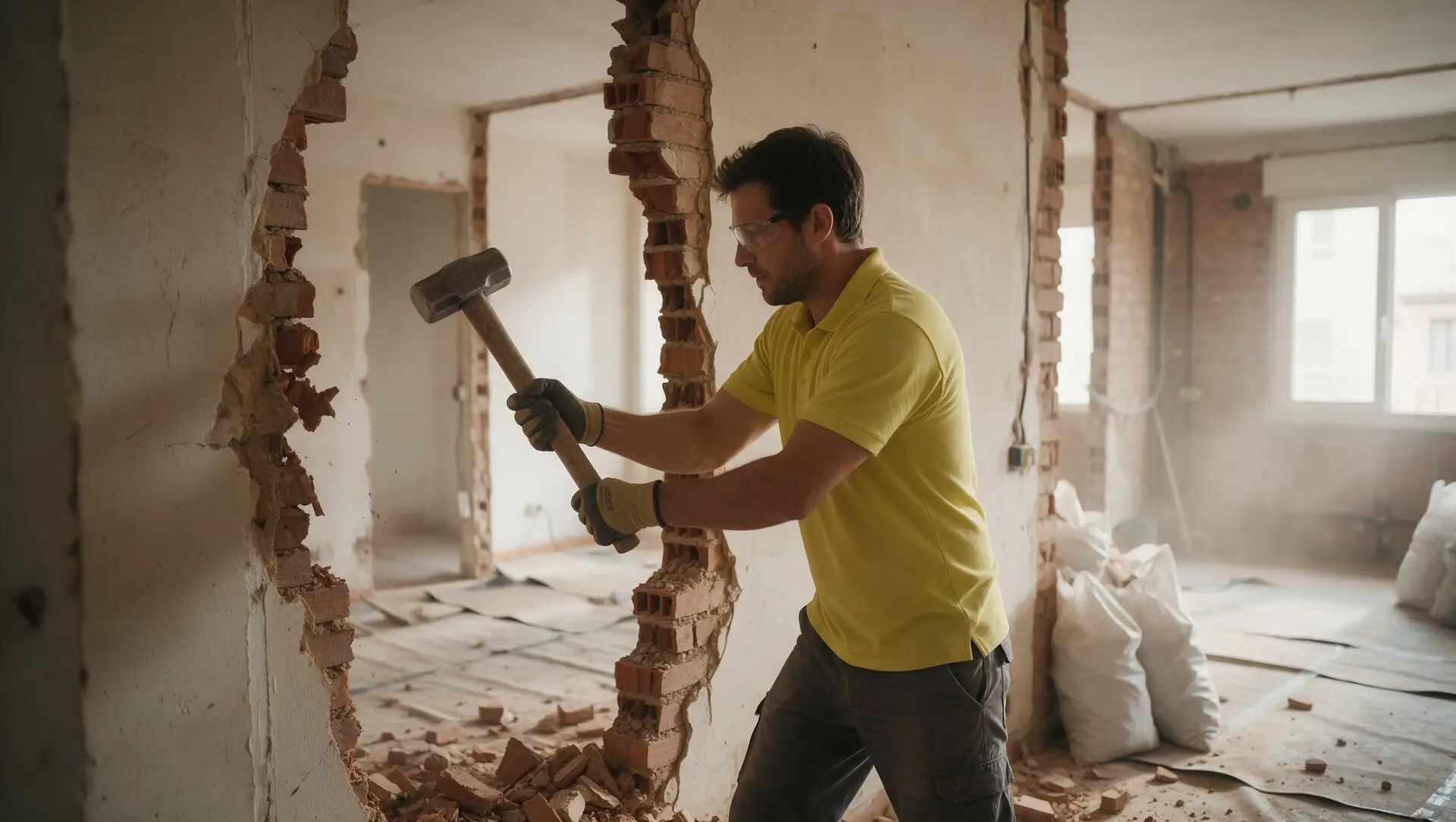
If your flat is in a building put up before 2002, the year asbestos was banned in Spain, it may contain some, mainly in fibre-cement downpipes, tanks and sheets, which most people in Spain call uralita. It is not dangerous while it is intact and left alone; the risk starts when it is broken, cut or sanded during a renovation. Only a firm registered in the RERA, with a work plan approved under Royal Decree 396/2006, may remove it. If it turns up on one of our jobs, we stop that part and coordinate such a firm.
Where asbestos usually turns up in a Barcelona flat
In the older buildings of the Eixample, Gràcia or Sant Antoni and in the 1960s and 1970s blocks of Nou Barris, Sants or L'Hospitalet, these are the places it is most often found:
- Fibre-cement downpipes and pipes, in light wells, galleries or inside kitchen and bathroom partitions.
- Water tanks on the roof terrace or in lofts, from the days before mains pressure was sufficient.
- Corrugated sheets on roofs over courtyards, terraces, storerooms and sheds.
- Ventilation and flue ducts, and some old planters.
- Some vinyl floor tiles and certain bituminous adhesives beneath them.
- Insulation on old boilers and heating pipes, as rope or blanket lagging.
This list confirms nothing on its own: some fibre cement contains no asbestos, and some materials contain it without looking like it. It tells you where to look and when to ask for an analysis.
Why it must not be touched
Asbestos is dangerous when it releases fibres into the air. Fibre cement in good condition is a compact material; a downpipe smashed with a sledgehammer, a sheet cut with an angle grinder or a tile that has been sanded turns it into dust that is breathed in and lingers in the stairwell. So when there is any suspicion the rule is simple: do not break, cut, drill or sand it, do not dry-sweep it and do not put it in the debris bag.
Who may remove it: RERA and the work plan
In Spain, any work with a risk of exposure to asbestos is governed by Royal Decree 396/2006. What matters for someone renovating a flat is this:
- The firm removing the asbestos must be registered in the RERA (Registro de Empresas con Riesgo por Amianto).
- Before starting, it submits a work plan to the labour authority, in Catalonia the Generalitat department responsible for employment, and the plan must be approved.
- Workers wear specific protective equipment, the area is sealed off and fibre levels are monitored.
- The material is wrapped, labelled and taken to a landfill or waste manager authorised for this waste, with its paperwork.
A renovation company that is not registered in the RERA cannot replace this process, however careful it is. Always ask the firm removing the asbestos to show proof of registration and of the approved work plan.
What we do when it turns up in a renovation
KONSTRUKT is not registered in the RERA and does not remove asbestos. What we do is make sure it is not disturbed by mistake and that the job does not grind to a halt without a plan:
- At the visit we check downpipes, light wells, ceilings and roofs, and point out anything that looks suspect.
- If it appears during demolition, we stop work in that area immediately and leave it untouched.
- We recommend a sample analysis and coordinate the visit, the work plan and the removal with a RERA-registered firm.
- If the element is communal, such as a main downpipe, we inform the property manager so the community can decide.
- We rearrange the schedule to continue with the parts of the job that are unaffected and return to the area once it is released.
In the quote we separate what we do from what depends on the RERA firm:
| Item | Who does it | Price |
|---|---|---|
| Interior strip-out of the rest of the flat | KONSTRUKT | €40–70/m²* |
| Lifting asbestos-free floors or tiling | KONSTRUKT | €10–25/m²* |
| Removal of asbestos-free debris | KONSTRUKT | by volume* |
| Removal of the asbestos-containing material | RERA-registered firm | that firm's own quote |
*Guide prices. You receive the final amount in writing, itemised, after the visit.
What makes removal cost more or less
We do not quote prices for asbestos removal because we do not carry it out and because it varies a great deal from job to job. In general terms, the cost depends on:
| Factor | Effect on cost |
|---|---|
| Quantity of material | more metres or pieces, higher cost |
| Condition of the material | damaged or friable, more measures and higher cost |
| Access | light wells, roofs or closed partitions add cost |
| Type of work | removal usually costs more than encapsulation |
| Work plan timing | prior approval adds time to the job |
The RERA firm provides its quote after seeing the element. We build it into the renovation schedule so you do not find the job stopped with no idea for how long.
The municipal asbestos census
Spain's Law 7/2022 on waste and contaminated soil requires town halls to draw up a census of installations and sites containing asbestos and a timetable planning its removal, starting with priority cases. The law set a deadline, but many municipalities are completing it later, and the details of how it affects private buildings are still being worked out. If your building may contain asbestos, ask the property manager and the Ajuntament de Barcelona where the census stands and whether the community needs to provide information.
If you are about to renovate a pre-2002 flat in Barcelona or the metropolitan area, tell us what you plan to do and send photos of downpipes, light wells or ceilings if you have doubts. We reply within 24 working hours, check it at the visit and send you a written quote that shows which part depends on a RERA-registered firm, before anything is touched.
Frequently asked questions
Questions on this topic
By eye you can only suspect it: grey fibre cement, a building from before 2002, old downpipes or tanks. Confirmation comes from a laboratory analysis of a sample, which should be taken by trained people without breaking or sanding the material.
No. Materials containing asbestos may only be removed by a firm registered in the RERA, with a work plan approved by the labour authority. Breaking, cutting or sanding it releases fibres that are dangerous to the workers and to the neighbours.
No. When a suspect material turns up in a renovation, we stop that part of the job, explain the situation and coordinate a RERA-registered firm. We carry on with the rest of the renovation once that firm has finished and the area has been released.
The main downpipes and the roof are usually common elements, so the decision and the cost normally fall to the community of owners. Anything inside the flat that serves only that flat is usually the owner's responsibility. Check your case with the property manager.
If it is in good condition and will not be disturbed, it does not always have to be removed straight away, but a renovation that affects it must involve a RERA-registered firm. Law 7/2022 also requires town halls to draw up a census of installations containing asbestos and a removal timetable, so obligations may change over time.