Demolition
Removing tiles and lifting floors: cost, and when you can tile over
· 6 min
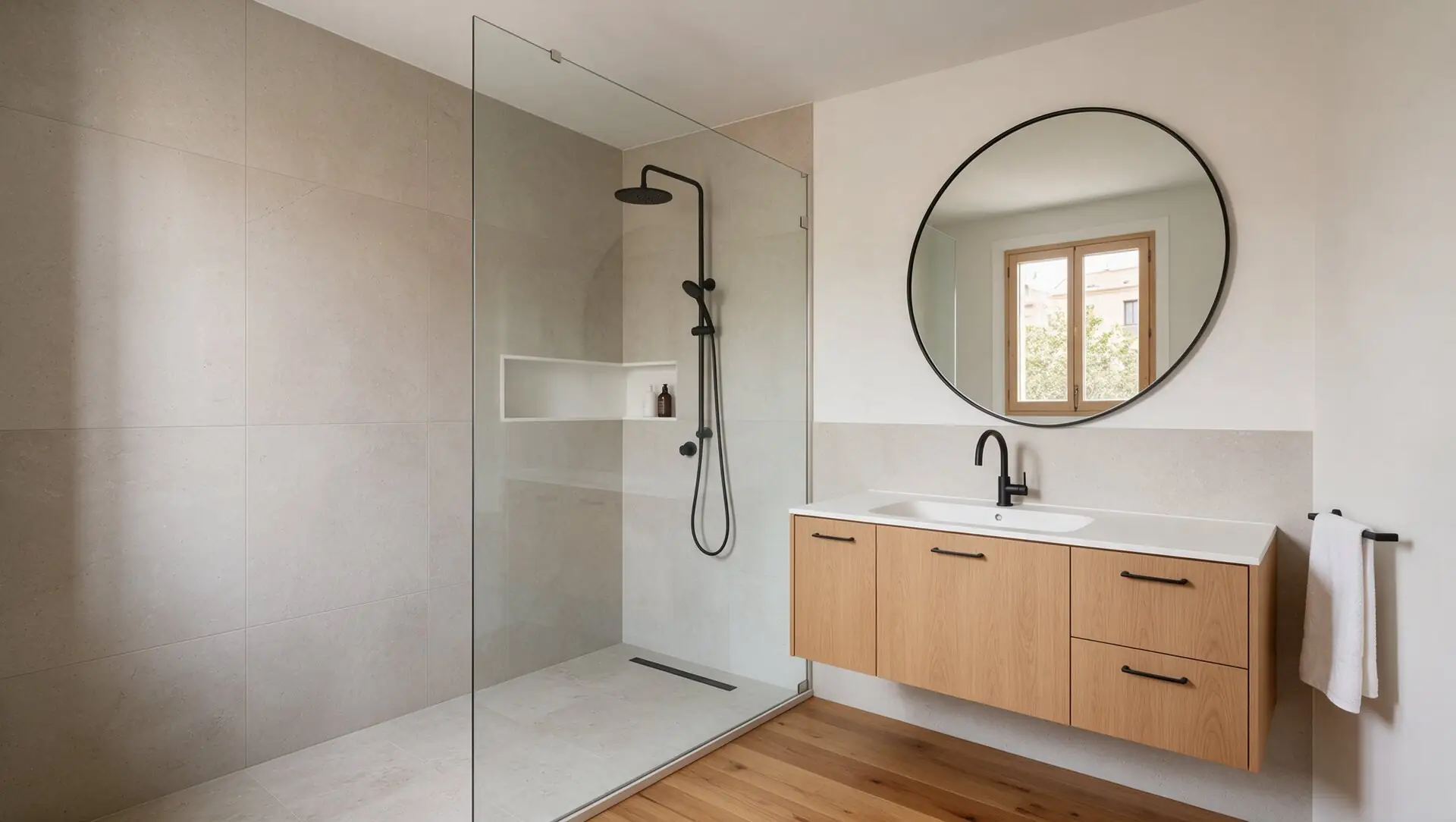
Removing tiles or lifting a floor in Barcelona costs roughly €10–25 per square metre in labour, plus debris removal, which is priced by volume. A standard bathroom comes to €230–575* for the demolition alone. Tiling, laying vinyl or applying microcement over the old surface is possible when it is solid, flat and dry, and when you don’t need to replace pipes or lose clearance under the doors; if any of those conditions fails, stripping is the sensible choice.
What stripping tiles and floors costs
Guide labour prices in Barcelona and its metropolitan area, per square metre of surface removed:
| Job | Guide price |
|---|---|
| Removing wall tiles | €10–25/m²* |
| Lifting a ceramic or tiled floor | €10–25/m²* |
| Typical bathroom: about 23 m² of floor and walls | €230–575* |
| Full interior strip-out of a flat | €40–70/m²* |
| Debris removal | by volume* |
*Guide prices. You receive the final figure in writing, broken down item by item, once we’ve seen the room.
What moves the price within the range
- How the tiles were fixed. Tiles set in cement on brick, typical of older buildings in Gràcia or Sant Antoni, come off with a hammer and leave a very uneven wall; tiles fixed with tile adhesive onto plaster come away with less effort.
- Layers. If someone tiled over the original years ago, there are two layers to break out and twice the debris.
- What the floor sits on. Tiles on a thick mortar bed mean part of the screed comes out too; a sound terrazzo floor is slow to lift and very heavy.
- Access. Carrying sacks down by hand from a fourth floor with no lift in Ciutat Vella or Poble-sec takes more hours than from a ground floor in Sant Martí.
- What turns up underneath. Damp, lead or galvanised steel pipes, or a broken subfloor add repair items that are not part of the stripping.
When you can cover the old surface
Tiling over tiles, laying vinyl over a tiled floor or applying microcement over the existing finish saves demolition, dust and debris. It works well when all of the following hold:
- Adhesion: tapping the tiles with a handle produces no hollow sound and none of them move. Odd loose tiles can be replaced, but if there are many, the new finish will pull the old one away.
- Flatness: the surface is even. Deep joints are filled and, on floors, a levelling compound goes on so the grout lines don’t show through vinyl or microcement.
- Height: a new floor on top adds thickness. Check the gap under the doors, the junction with the hallway floor, the shower tray and the toilet outlet before you decide.
- Weight: another layer of ceramic adds load. In buildings with timber beams or old vaulted floors, as in many in the Eixample, avoid stacking layers without someone assessing the floor structure.
- Dryness: no stains, efflorescence or damp smell. Covering active damp with a new finish only hides it for a few months.
- Services: you are not replacing pipes or moving waste outlets. If the plumbing is old, renewing it while the wall is open is easier and avoids breaking the new finish later.
When it pays to strip everything
Stripping costs more up front, but in many older Barcelona flats it is the option that causes fewest problems. We recommend it when the tiling sounds hollow in several places, when concealed plumbing or wiring needs renewing, when the wall is damp or the floor is out of level, and when there are already two layers. Also when a bathroom or kitchen layout changes: waste outlets and water points are much easier to move with the substrate exposed.
One special case: the original hydraulic tile floors (suelo hidráulico) found in many buildings in the Eixample, Gràcia or Sants. Before lifting or covering one, consider restoring it. Once lifted, it is gone; if you cover it, use a system that won’t damage it, in case you want it back one day.
| Situation | Cover over | Strip |
|---|---|---|
| Tiles firm, surface flat, no damp | Valid option | Not essential |
| Hollow or loose tiles in several areas | Not advisable | Advisable |
| Pipes or waste outlets being replaced | Not advisable | Advisable |
| Active damp in wall or floor | No: fix the cause first | Advisable |
| Little clearance under the doors | Only with a height solution | Advisable |
How we carry out a strip-out
- Visit: we tap the tiles, check levels, damp and services, and tell you whether covering over is an option.
- Written quote, with stripping, debris, substrate repairs and the new finish as separate items.
- Paperwork: a works notification to the Ajuntament where needed and a heads-up to the building’s administrator.
- Protection of floors, doors and communal areas; water and power cut off in the room.
- Stripping in sections with debris taken away continuously in sacks; if a skip is needed in the street, we apply for the public-highway permit.
- Substrate preparation: making walls good, repairing the subfloor and leaving a base ready for the new finish.
In buildings from before 2002, asbestos cement can turn up in downpipes, ducts or sheets near the bathroom or kitchen. If we find it, that part of the work stops and removal is carried out by a firm registered in the RERA (the register of companies handling asbestos) with an approved work plan. Never break or sand it yourself.
If you can’t decide between stripping and covering over, send us photos of the bathroom or kitchen and tell us what you want to put in. We reply within 24 working hours, come and take a look, and send you a written quote with each item listed separately. We work across Barcelona, the metropolitan area from L’Hospitalet to Badalona and Sant Cugat, and the rest of the province.
Frequently asked questions
Questions on this topic
Removing wall tiles and the floor costs roughly €10–25/m²*. A small bathroom with about 5 m² of floor and 18 m² of wall adds up to around 23 m², so €230–575* for the demolition alone, plus debris removal, which is quoted by volume.
Yes, if the old tiles are firmly bonded, the surface is flat and there is no damp and no pipework to replace. The tiles must be cleaned and degreased, then primed with a bonding primer or laid with an improved cement-based adhesive, and you have to accept the extra thickness. If tiles sound hollow or are cracked, the right answer is to strip them.
Yes, when the tiles are solid and flat. Vinyl needs a smooth base, sometimes with a levelling compound so the grout lines don’t show through; microcement needs a primer, mesh and filled joints. Over loose or damp tiles, both will eventually fail.
In a normal-sized bathroom, stripping and debris removal usually take one or two working days. If damp or failing pipes turn up, the repair days are added before the new finish goes on.
Replacing interior finishes without touching the structure, façade or communal elements is usually handled in Barcelona with a comunicat d’obres (works notification) to the Ajuntament. A rubble sack or skip on the street needs authorisation to occupy the public highway. Confirm the procedure with the Ajuntament or ask us during the visit.