Demolition
Building debris removal in Barcelona: bags, skips and permits
· 6 min
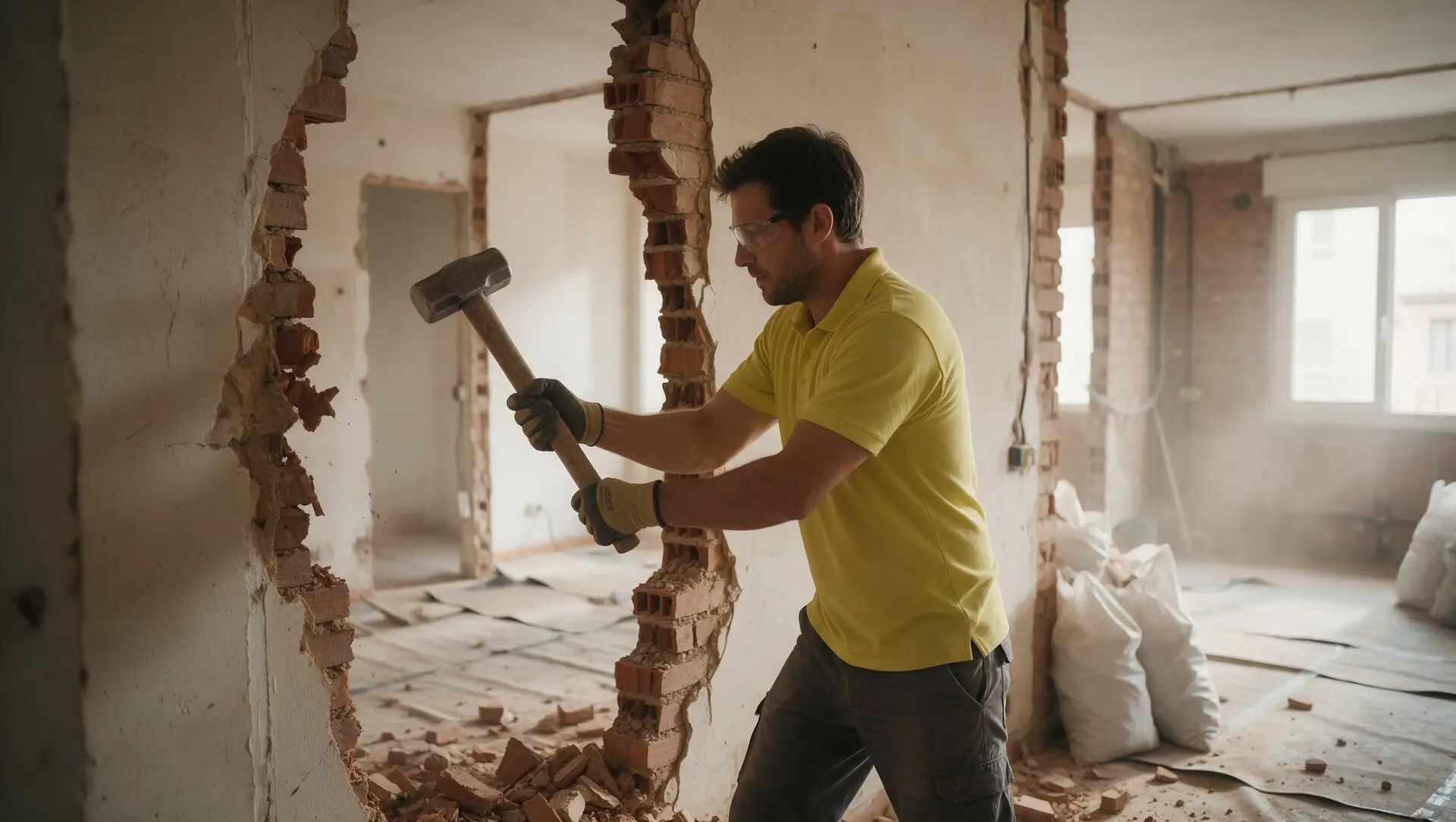
In Barcelona, debris from a renovation leaves in one of three ways: in builder's bulk bags collected by a crane lorry, in a skip on the street or, for small volumes, by van straight to an authorised waste manager. It is priced by volume*, and the main drivers are quantity, how mixed the materials are and access. If the bags or skip sit on the street, you need municipal authorisation to occupy the public highway, and the Ajuntament may ask for the waste manager's certificate showing where the waste went.
Bulk bags, skip or crane lorry
Each system has its place, and many jobs combine them:
| System | Suits which job | Price |
|---|---|---|
| Bulk bags with crane lorry | bathroom, kitchen, partitions, narrow streets | by volume* |
| Skip in the roadway | full strip-out, a lot of debris | by volume* |
| Van to the waste manager | small, separated loads | by volume* |
*Guide prices. The final cost of removal appears in writing, as a separate item, in the job quote.
Bulk bags, the canvas big bags with lifting loops, are the norm in Barcelona. They take up little room, are filled inside the entrance hall or beside the kerb, and a lorry with a crane arm lifts them away. They suit the narrow streets of Ciutat Vella, Gràcia or Poble-sec, where a skip would not fit or would block the way.
A steel skip takes far more volume and pays off on a full interior strip-out or a house clearance. It needs space in the roadway, usually in a parking lane, and room for the lorry to manoeuvre. On wide streets in the Eixample, Sant Martí or Nou Barris it is usually workable; on others it is not.
For small, well-separated loads, such as the debris from a small bathroom, it is sometimes enough to load a van and take it straight to an authorised waste manager without occupying the street at all.
Permit to occupy the public highway
Any bag or skip left on the pavement or in the roadway occupies public space, and in Barcelona that requires municipal authorisation, normally with a fee that depends on the space and the time. In many cases the skip company or the renovation contractor arranges it, but the quote should make clear who does.
The specific conditions (where it may go, for how long, signage, loading hours, protecting the paving) vary by street and district, and in pedestrian or restricted-traffic areas they can be stricter. So we take nothing for granted: we confirm with the Ajuntament before fixing the demolition date. If the bags are filled inside the flat or the entrance hall and the lorry only stops while loading, the situation is different, and that too is worth checking.
Authorised waste manager and waste certificate
Building debris cannot end up just anywhere. It has to reach an authorised construction-waste plant or manager (gestor autorizado), which issues a receipt stating the type and quantity. In Barcelona the Ajuntament may ask you to prove this, for example when closing the works notification or licence, so the certificate is not a minor piece of paper.
- Ask for the quote to state what type of waste manager the debris goes to.
- Keep the receipt for each collection with the rest of the job's paperwork.
- If the contractor handles the paperwork, ask for a copy of the certificate at the end.
- Be wary of removal with no paperwork at all: responsibility for the waste stays with whoever produces it.
Separating materials makes it cheaper and easier
Waste managers deal less easily with mixed debris, and it usually costs more than clean loads. On site we separate what we can from the start:
- Inert waste: brick, ceramics, tiles, concrete and mortar.
- Gypsum and plasterboard, best kept apart from the inert waste.
- Timber: doors, frames, parquet and dismantled kitchen units.
- Metals: pipes, radiators, profiles and cable.
- Plastics, cardboard and packaging from new materials.
What does not go in a debris bag
- Asbestos: fibre-cement downpipes, tanks or sheets. Only a RERA-registered firm with a work plan may remove it.
- Paints, varnishes, solvents, adhesives and their containers: hazardous waste, for a recycling point or a specialist manager.
- Household appliances and electrical equipment, which have their own collection circuit.
- Furniture and household junk, which go through the city's bulky-item collection or a clearance service.
- Contaminated soil, oils, batteries or fluorescent tubes.
What sets the price of removal
We do not give a price per bag or per skip without seeing the job, because it varies a lot from case to case. These are the factors that count:
- Total volume in cubic metres, which depends on what is demolished and how many layers there are.
- Mix: clean, separated debris costs less to process than mixed debris.
- Floor and lift: carrying bags down five floors with no lift takes many labourer hours.
- Distance from the flat to the loading point and whether the lorry can stop nearby.
- How long the street is occupied and the municipal fee that applies.
- Whether a crane lorry, several trips or collections on different days are needed.
If you have a renovation or a clearance in Barcelona or in metropolitan towns such as Badalona or Cornellà, tell us what is coming out and which floor the flat is on. We reply within 24 working hours, look at it during the visit and send you a written quote with debris removal as its own item and the waste manager stated.
Frequently asked questions
Questions on this topic
It depends on the volume and the street. Bulk bags suit bathroom, kitchen or partition jobs and narrow streets where a skip will not fit. A skip pays off on full strip-outs with a lot of debris, provided there is room in the roadway and authorisation to occupy the public highway is obtained.
Yes. Occupying the public highway with a skip or with bulk bags requires municipal authorisation and usually a fee. The skip company or the contractor often handles it. Confirm the conditions with the Ajuntament or with us before work starts.
It is quoted by volume*. The cubic metres, whether the debris is separated or mixed, the floor and whether there is a lift, the distance to the loading point, how long the street is occupied and whether a crane lorry is needed all play a part. We give it to you in writing, as a separate item, after the visit.
No. A builder's bag is for construction waste. Paints, solvents and their containers go to a punto verde (municipal recycling point) or a hazardous-waste manager, and fibre cement that may contain asbestos can only be removed by a firm registered in the RERA.
It is the document an authorised plant or waste manager issues when it receives the debris, stating the quantity and type of waste. The Ajuntament may ask for it as proof that the job's waste was handled properly, so keep it with the works notification or licence papers.