Damp
Rising damp in ground-floor flats and shops: causes and treatments
· 7 min
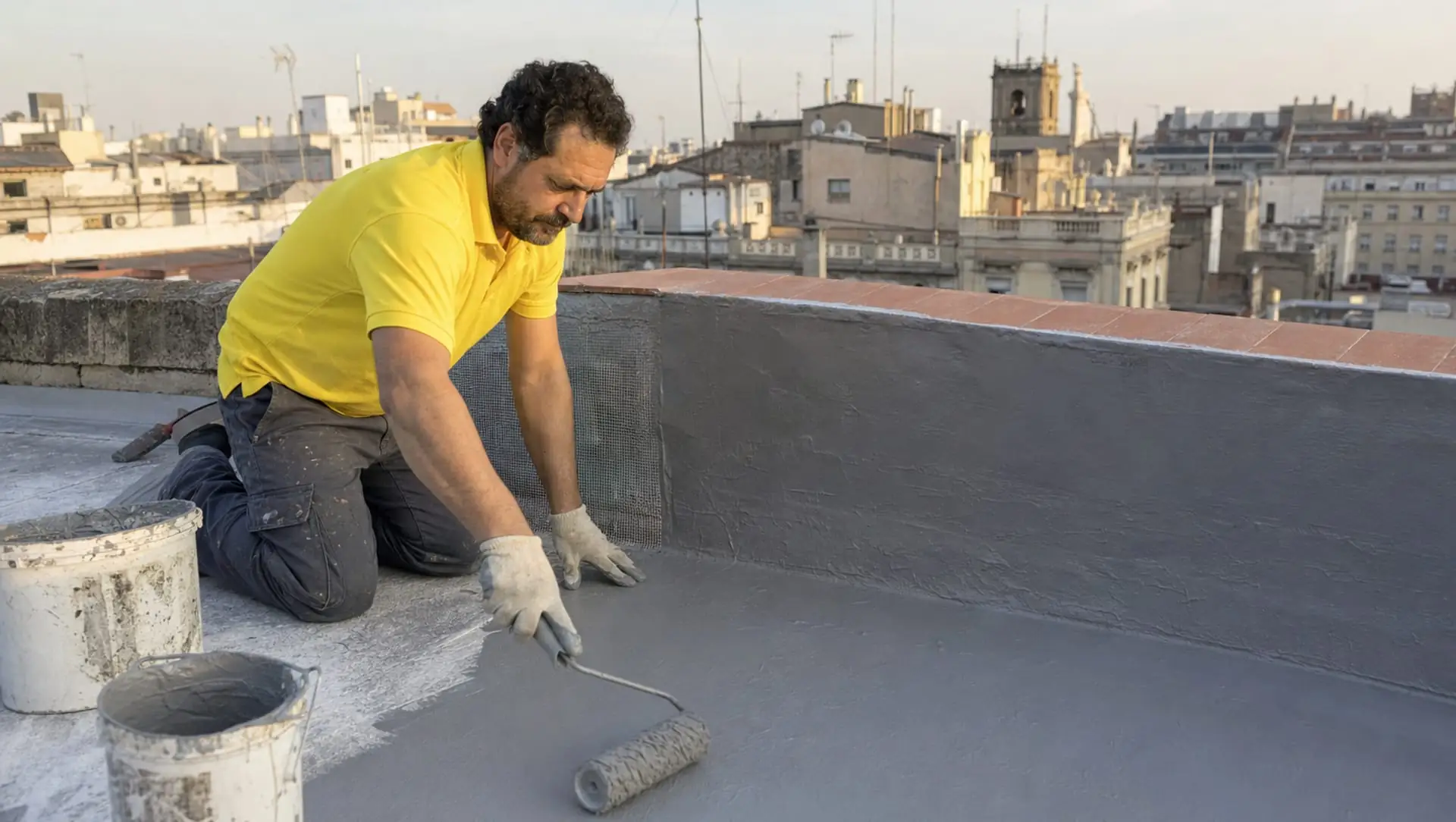
Rising damp is solved by stopping water climbing from the ground, usually with a chemical damp-proof course injected into the base of the wall, and by replacing the damaged plaster with a breathable renovation (salt-retaining) render. Paint alone will not fix it. Before treating, you need to confirm it really is rising damp: a survey with moisture readings starts from €80*, and the treatment price is given in writing afterwards, depending on the wall. Expect a few days of work and several months of drying before the final finish.
Why damp rises in old ground-floor flats and shops
Walls of solid brick, stone or rammed earth soak up water from the ground like a sponge: it travels up through the pores until it reaches a height where it can evaporate. Modern buildings have a waterproof membrane between the foundations and the wall to stop this. In many older Barcelona buildings there is none, or it has failed.
That is why it is so common in ground-floor flats (plantas bajas) and shop units in Ciutat Vella, the Raval, Poble-sec, Gràcia, Sants or the old centres of Sant Andreu and Horta, and in older terraced houses in L'Hospitalet or Badalona. Narrow streets with little sun, unventilated inner courtyards and the shallow water table near the sea, in areas such as Barceloneta or Poblenou, make it worse.
- A stain with a horizontal edge at roughly the same height along the wall, often between 50 cm and 1.5 m.
- Salts: white powder or crust left as the water evaporates.
- Bubbling paint, crumbling plaster and skirting boards coming away.
- A musty smell low down in the room, worse in winter and after several days of rain.
None of these signs is conclusive. A leaking downpipe, a buried pipe or condensation on a cold wall can produce similar stains. If you want to go over the differences, we have a guide on telling rising damp, condensation and water ingress apart.
What makes it worse: plastic paints and cement renders
The most common mistake is trying to cover the damp up. If you coat a damp wall with plastic paint, a cement render or a tiled skirting, you block the vapour’s way out. The water keeps rising and, unable to evaporate low down, appears higher up, carrying more salts. Many ground floors in older buildings have a stain at a metre and a half for exactly this reason: someone put cement and tiles on the first 80 cm.
The same happens with anti-damp paints applied to a wall that is still getting wet from below. They may last a few months, but they do not address the cause. And if the original lime render is still sound, it is better to keep it and work with compatible materials.
Treatments that work
A single measure is rarely enough. The usual approach combines several, depending on the wall, how the space is used and the budget:
- Chemical damp-proof course by injection: holes are drilled at short intervals along the base of the wall and a water-repellent cream or liquid, usually silane/siloxane-based, is injected to form a band the water cannot cross. It is the most widely used treatment for brick and rubble-stone walls.
- Plaster removal and renovation render: the salt-contaminated plaster is stripped, normally to well above the visible stain, and a macroporous render is applied that lets vapour out and stores salts inside it without them blooming on the surface.
- Drainage and ventilation: on walls against the ground, a ventilated cavity, an independent lining set off the wall or perimeter drainage, where there is access from outside, reduce the water reaching it. In closed shop units, cross-ventilation or an extractor fan helps the wall dry.
- Breathable finishes: silicate, lime or mineral paints, and no plastic paints or tiled skirtings while the wall is drying.
- Electro-physical or electro-osmosis systems: they exist and some manufacturers offer guarantees, but their effectiveness is disputed and depends heavily on the wall. If you are considering one, ask for readings before and after.
On party walls or walls against a neighbour’s ground, a chemical barrier injected from one side may not be enough, and sometimes the answer is a ventilated lining. It is one of the decisions taken once the wall has been opened up and measured.
Guide prices and timings
Injecting a 25 cm wall does not cost the same as a 60 cm stone wall, and stripping an open-plan shop is not the same as a flat with built-in wardrobes. That is why the treatment is quoted after measuring:
| Stage | Guide price | Guide duration |
|---|---|---|
| Survey with moisture readings and photo report | from €80* | 1 visit |
| Chemical damp-proof course by injection | price after survey* | 1–3 working days |
| Plaster removal and renovation render | price after survey* | 3–7 working days |
| Wall drying | — | several months |
| Final breathable paint | from €8/m²* | 1–2 days |
*Guide prices. You receive the final amount in writing, itemised, after the survey.
What moves the price most: the thickness and material of the wall, the linear metres affected, how high the salts have reached, whether skirtings, furniture or services have to be removed, and the finish you want at the end.
How we work, step by step
- Visit and moisture readings at several heights and points, to confirm it is rising damp and rule out leaks or condensation.
- Photo report and proposed treatment, with a written, itemised quote.
- Floor protection and removal of skirtings and damaged plaster.
- Chemical damp-proof course and, if needed, a lining or improved ventilation.
- Renovation render and a drying period with the space ventilated.
- New readings and a breathable paint finish once the wall allows it.
If the wall is a communal element of the building, such as the façade or a load-bearing wall, tell the building administrator (administrador de fincas): the owners’ association may have to act, and a report with readings helps raise it at the general meeting.
If you are renovating the ground floor
If you are planning to renovate the shop or ground-floor flat, treat the damp first, not afterwards. Order matters: stop the water, then install floors, services and finishes. Fitting a kitchen, wardrobes or wooden flooring against a wet wall is the quickest way to have to take it all out again a year later.
If you have stains low on the walls of your ground-floor flat or shop, send us a few photos and the approximate address. We reply within 24 working hours, measure the damp on our visit and give you in writing what it is, which treatment our team proposes and what each item costs. Labour carries a 2-year guarantee, and we work in Barcelona, the metropolitan area and the province.
Frequently asked questions
Questions on this topic
The typical signs are a stain with a horizontal edge low on the wall, white salt deposits, paint that bubbles and skirting that comes away, all on walls in contact with the ground. Condensation and leaks can leave similar stains, so it is worth measuring moisture at several heights before choosing a treatment.
A survey with moisture readings and a photo report starts from €80*. The treatment depends on the wall’s thickness and material, the linear metres affected and the finish, so the price is given in writing after the survey, with the damp-proof course, plaster removal, new render and paint as separate items.
The work itself usually takes from a few days to a week, but the wall needs months to release the water it holds. Thick stone or brick walls in older buildings can take considerably longer. Meanwhile, keep the space ventilated and avoid sealing the wall with impermeable finishes.
No. A plastic or waterproof paint seals the surface, and the water climbs higher looking for somewhere to evaporate. What works is stopping the water rising and finishing with breathable renders and paints.
There are electro-physical systems that claim to stop water rising, but their results are disputed and depend heavily on the wall. If you are offered one, ask for moisture readings before and after and a written guarantee.