Damp
Waterproofing a leaking terrace: cost and systems
· 7 min
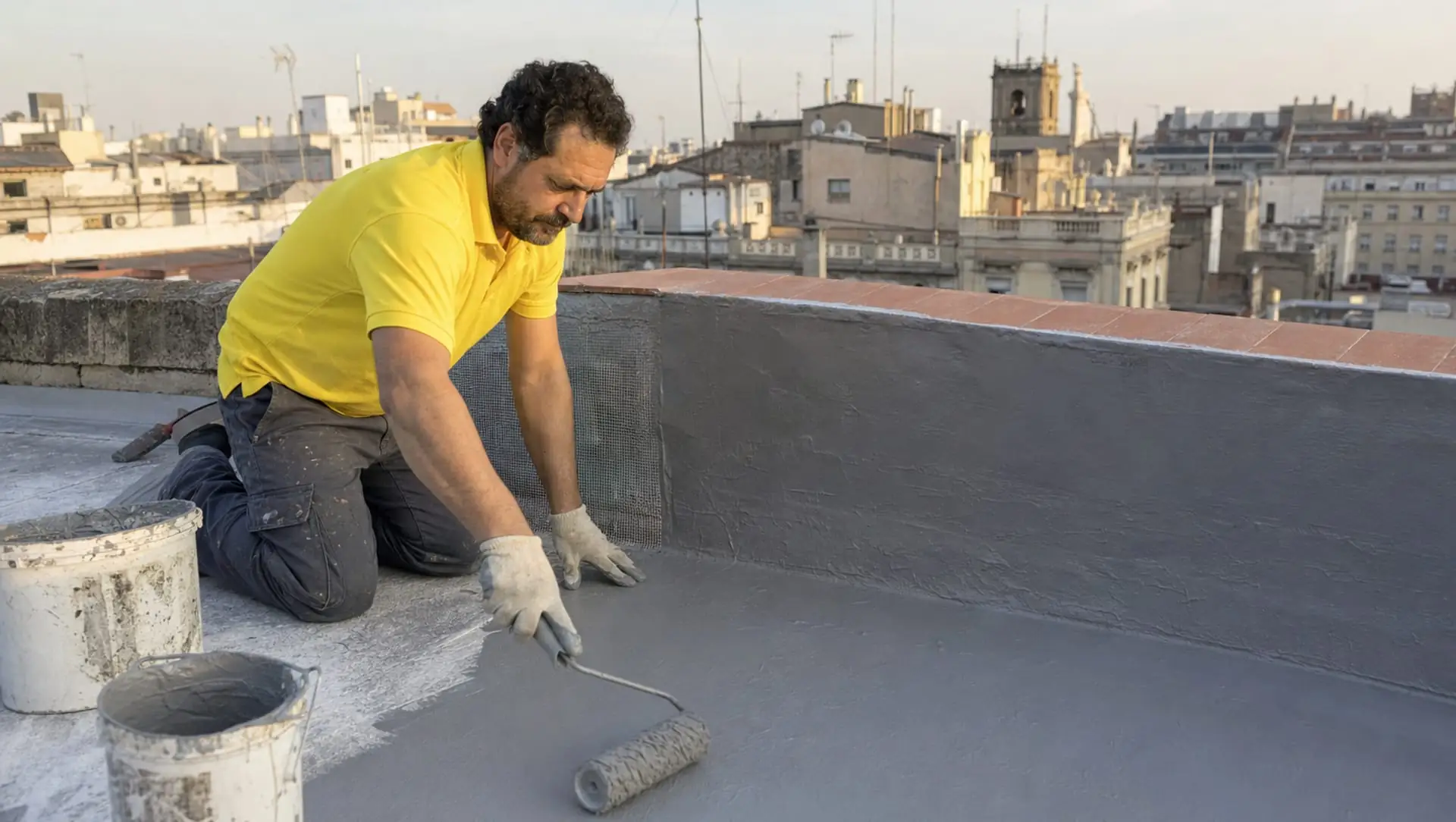
As a guide, waterproofing a terrace in Barcelona costs from €45/m²* if the paving is in good condition and a trafficable liquid membrane is applied over it, and from €90/m²* if the floor has to be lifted, re-waterproofed and new paving laid. On a 20 m² terrace that means from around €900 or from around €1,800 respectively. The condition of the paving and the old waterproofing decides the system; the drains, parapets and joints decide whether the job lasts.
Finding where the water gets in
A stain on the ceiling of the flat below does not always come from directly above. Water can enter through a drain, travel through the screed under the paving and appear several metres away. Before quoting, the entry point has to be found:
- Drains: the junction between the outlet and the waterproofing is the most common failure point.
- Parapets and upstands: cracks in the coping, loose capping stones and the junction between floor and wall, where the membrane should turn up a few centimetres.
- Expansion joints and open or unsealed joints between tiles.
- Hollow paving, loose tiles or falls that leave puddles that never dry.
- Terrace doors with a threshold that is too low or badly sealed.
- Anything fixed through the floor: awning brackets, railing anchors, air-conditioning or solar panel pipework.
Waterproofing systems
- Liquid polyurethane or other resin membranes: applied in several coats, with reinforcing mesh at junctions and cracks, over the existing paving or on a new substrate. They form a continuous layer with no overlaps. Some versions are trafficable and stay exposed; others are protected with paving.
- Bituminous felt (tela asfáltica): bitumen sheets torch-welded in one or two layers. The classic system on many Barcelona roofs; it needs protection on top, usually paving, and is laid with the floor lifted.
- Synthetic EPDM or PVC sheets: flexible rubber or plastic membranes, welded or bonded, widely used on flat and green roofs. They cope well with movement, but junctions and seams must be done carefully.
There is no best system in the abstract. A liquid membrane is the quickest option when the floor is sound; felt and sheet membranes make sense when everything is lifted or on large roofs. What matters most for durability is how the junctions with parapets, drains and joints are detailed, and that the substrate is dry and clean.
Guide prices and timings
| Work | Guide price | Guide timing |
|---|---|---|
| Leak survey with report and photos | from €80* | 1 visit |
| Liquid membrane over existing paving | from €45/m²* | 2–4 days |
| Lifting, waterproofing and new paving | from €90/m²* | 1–3 weeks |
| Watertightness or flood test | depends on system* | 24–72 h |
*Guide prices. You receive the final amount in writing, itemised, after we have seen the terrace.
What moves the price: the square metres and linear metres of parapet, the number of drains, whether falls need redoing, the paving chosen, access for carrying materials up and rubble down, and whether scaffolding or a permit to occupy the street is needed. A small terrace has a minimum amount of work, so the price per metre rises as the area shrinks.
Barcelona’s flat roofs (terrats)
Many buildings in the Eixample, Gràcia or Sant Antoni have a walkable communal flat roof, the terrat, with ceramic tiles over layers of thin brick and, at best, an old membrane underneath. These roofs last decades, but they collect aerials, washing lines, air-conditioning units and patch repairs. Every badly sealed fixing is a way in for water.
In these cases, patching one drain is usually a temporary fix. If leaks keep appearing in several flats, it makes sense to propose full waterproofing at the owners’ meeting and check parapets, chimneys and downpipes at the same time. If the work affects the roof or the façade, it may need a different municipal procedure from a comunicado de obras (works notification); confirm with the Ajuntament (city council) or a qualified professional.
Private terrace or communal roof: who pays
This is the question that causes most arguments. Many penthouse terraces are both for the owner’s private use and the roof of the building. In Catalonia, property in buildings divided into flats is governed by the Catalan Civil Code, and in the rest of Spain by the Ley de Propiedad Horizontal; under both, the structure and the roof waterproofing are usually treated as communal elements, even when only one neighbour uses the terrace. In practice, the owners’ association often pays for the waterproofing, while the owner covers the paving, cleaning the drains and damage caused by their use, for example by anchoring a pergola.
However, the bylaws, the deed of division and the specifics of each case can change the split, and the courts have not always ruled the same way. Before commissioning the work, talk to the building administrator. A report with photos and readings showing where the water gets in helps the owners’ association or the insurer decide.
How we do it
- Visit, inspection of the terrace and the affected ceiling, and locating the entry point.
- Written quote with the proposed system and separate items: preparation, waterproofing, parapets, drains, paving and rubble.
- Substrate preparation: cleaning, crack repair, joint sealing and, if needed, lifting and new falls.
- Reinforcing junctions with parapets, drains and service penetrations before waterproofing the main surface.
- Applying the system and a watertightness test before the finish goes down.
- Final paving or trafficable layer, plus maintenance advice: clear the drains and check joints once or twice a year.
If you have a stain on a ceiling under a terrace, send us photos of the terrace and the affected ceiling. We reply within 24 working hours, locate the entry point on our visit and send you a written quote with the proposed system and each item listed separately, which you can also use with the owners’ association or your insurer. Labour carries a 2-year guarantee.
Frequently asked questions
Questions on this topic
With a liquid membrane over the existing paving, from around €900* (from €45/m²*). If the floor has to be lifted, with new waterproofing and new paving, from around €1,800* (from €90/m²*). Parapets, drains and access equipment can add to that, and the final price is given in writing after the visit.
Yes, if the paving is well bonded, with no loose tiles or large cracks, and the falls carry water to the drains. In that case a trafficable liquid membrane is applied over the top. If the floor sounds hollow or the old membrane has failed, the right approach is to lift it and start again.
It depends on the building’s bylaws, its deed of division and the cause of the damage. The roof waterproofing is often treated as a communal element even when only one owner uses the terrace, while routine upkeep and damage caused by use fall to that owner. Check with your building administrator before commissioning the work.
A liquid membrane on a medium-sized terrace usually takes two to four days because of drying time between coats, and it depends on the weather. If the paving is lifted, allow one to three weeks. The watertightness test comes on top of that.
The drains are plugged and the terrace is flooded with a few centimetres of water for one to three days, or sprayed continuously if it cannot be flooded, and the ceiling below is checked for leaks before the finish is laid or the job is signed off.