Demolition
Knocking down a wall in Barcelona: cost per m² and permits
· 6 min
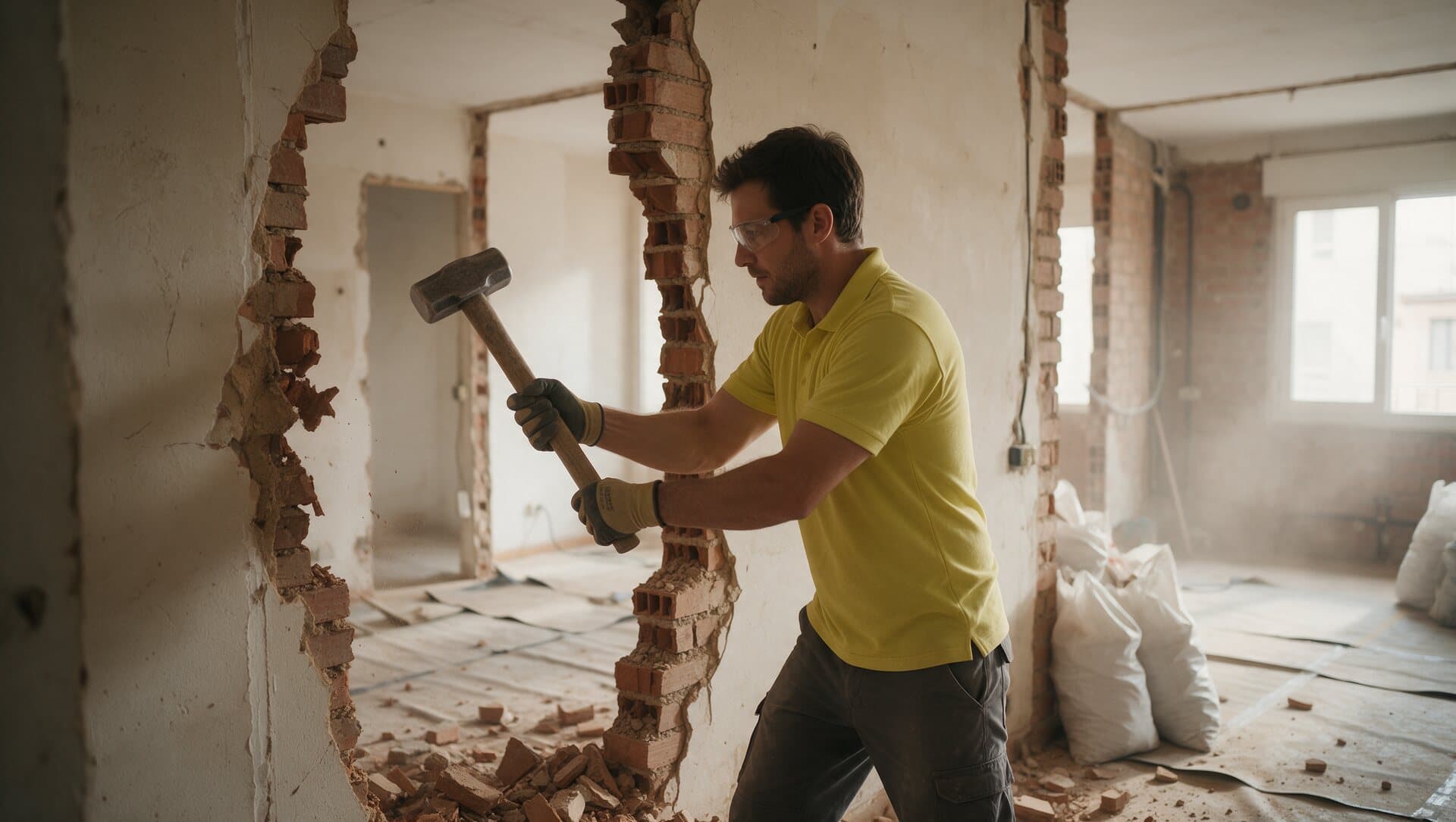
As a guide, taking down a non-load-bearing wall in Barcelona costs €15–35 per square metre of wall, depending on the material and what runs inside it, plus rubble removal, which is priced by volume. A typical partition 3 metres long and 2.70 metres high is around 8 m², so the demolition itself usually comes to €120–285 before rubble and making good. As for permits, interior work that doesn’t touch the structure usually goes through a prior notification to the Ajuntament (city council); if the wall is load-bearing, you need a technician, a project and a municipal licence.
What it costs to knock down a wall
Guide labour prices in Barcelona and its metropolitan area, per square metre demolished:
| Job | Guide price |
|---|---|
| Partition wall demolition | €15–35/m²* |
| Floor or tile stripping | €10–25/m²* |
| Full interior demolition of a home | €40–70/m²* |
| Rubble removal | by volume* |
*Guide prices. You receive the final figure in writing, broken down item by item, once we’ve seen the wall.
What makes a wall cheaper or more expensive to remove
The range is wide because no two walls come down the same way. These are the factors that weigh most on the price:
- The material. A plasterboard wall comes apart quickly and produces little rubble; a solid brick partition, common in older buildings in Eixample or Gràcia, takes more hours and fills more bags.
- What covers it. If the wall is tiled on one or both sides, as in bathrooms and kitchens, there’s more to chip off and more weight to carry down.
- What runs inside it. Sockets, switches, pipes or a radiator mean the services have to be rerouted or disconnected before demolition.
- Access. A fifth-floor flat with no lift in Ciutat Vella is a different job from a ground-floor flat in Sant Martí: carrying rubble down by hand takes time.
Partition or load-bearing wall?
This is the question that decides everything else, and you can’t answer it by eye. In Barcelona’s older buildings there are clues worth knowing, although none of them is conclusive on its own:
- Thickness: a load-bearing wall is usually thicker than a partition, but some thin walls carry load and some thick ones don’t.
- Position: walls parallel to the façade, walls backing onto the stairwell, and walls that repeat in the same place on every floor should all raise suspicion.
- Floor structure: if the ceiling beams rest on that wall, the wall is holding something up.
- Plans: the building administrator or the municipal archive may have plans of the building that help confirm it.
Older buildings have a particular quirk: over the years, some partitions that were never built as structure end up taking load because the beams above have sagged. If there’s any doubt, a qualified professional (an architect, a technical architect or an engineer) must assess the wall before anyone touches it. If it is load-bearing, the job is no longer a simple demolition: you need a project that works out how the load will be redistributed, usually with a beam or a portal frame, a municipal licence and the agreement of the owners’ association, because the structure is a communal element.
What Barcelona’s Ajuntament requires
For a non-structural interior partition, the usual procedure in Barcelona is to submit a prior notification of works to the Ajuntament before you start, in most cases online. It’s a lighter procedure than a licence, but it still has to be done. When the work affects the structure, the façade or communal elements, the procedure changes and usually requires a technical project and a licence.
On top of the procedure itself, there may be a municipal fee and the construction tax, which is calculated on the cost of the works, and the Ajuntament may ask you to prove that the rubble went to an authorised waste handler. If the building is listed or sits in a protected area, which is common in Eixample and Ciutat Vella, extra conditions may apply. Because the rules change, confirm the exact procedure with the Ajuntament, or ask us during the visit and we’ll tell you what paperwork you’ll need.
Don’t forget the owners’ association. Even if you don’t need their permission for an interior partition, it’s a good idea to let the building administrator know: there will be noise, some dust on the stairs and the lift will be used to take bags down. Keep to the hours set in the building’s rules and the municipal noise regulations.
How a wall comes down, step by step
- Visit: we look at the wall, the services running through it and the condition of the floor and ceiling.
- A written quote with every item listed separately: demolition, rubble, rerouting services and making good.
- Municipal paperwork and notice to the owners’ association before we start.
- Protection for floors, doors and communal areas, and electricity and water cut off if needed.
- Demolition in sections, from the top down, with rubble bagged and removed as we go.
- Making good: the floor, the ceiling, the broken ends of the adjoining walls and any services that ran through the wall.
What the per-m² price doesn’t include
Where a partition used to stand, you’re left with a strip of bare floor, a mark across the ceiling and two broken wall ends. In flats with original encaustic cement tiles it isn’t always possible to find tiles that match the rest, and sometimes it makes more sense to relay the floor across the whole room. Plaster cornices, replastering the adjoining walls and painting all count too. All of this is quoted separately, and it’s better to see it on paper before you decide.
Rubble is charged by volume. Many Barcelona streets have no room for a skip, so the norm is to use large rubble sacks collected by lorry; if a skip on the street is needed, it requires municipal authorisation to occupy the public highway. In buildings from before 2002 you also have to think about asbestos: if asbestos-cement pipes or sheets turn up, that part of the job stops and removal is carried out by a company listed on the official register of firms authorised for asbestos work (RERA).
If you’re thinking of opening up the kitchen to the living room or joining two rooms, tell us which wall you want to remove and, if you can, send us a photo. We’ll reply within 24 hours on working days, come and see it and send you a written quote, with demolition, rubble and making good listed separately, before anything is touched. We work across Barcelona and the metropolitan area, from Sants-Montjuïc to Sant Andreu and from L’Hospitalet to Badalona.
Frequently asked questions
Questions on this topic
At the guide rate of €15–35/m², demolishing 10 m² comes to between €150 and €350* depending on the material. Rubble removal and making good the floor, ceiling and walls are extra and quoted separately.
If the wall isn’t load-bearing, the usual route is a prior notification to the Ajuntament (city council), not a licence. If it’s structural, you need a technical project and a licence. Confirm the exact procedure with the Ajuntament or with us before you start.
Its thickness, its position and whether beams rest on it are all clues, but they aren’t enough. In older buildings some partitions have ended up carrying load over the years, so confirmation has to come from a qualified professional.
Taking down an ordinary partition usually takes a day; making good the floor, ceiling and paintwork adds a few more days depending on the finish.
For an interior partition you don’t usually need their permission, but it’s wise to let the building administrator know about the noise and the use of communal areas. If the work affects the structure, the façade or other communal elements, you need their agreement.