Air conditioning
Air conditioning in older Barcelona flats: which system?
· 6 min
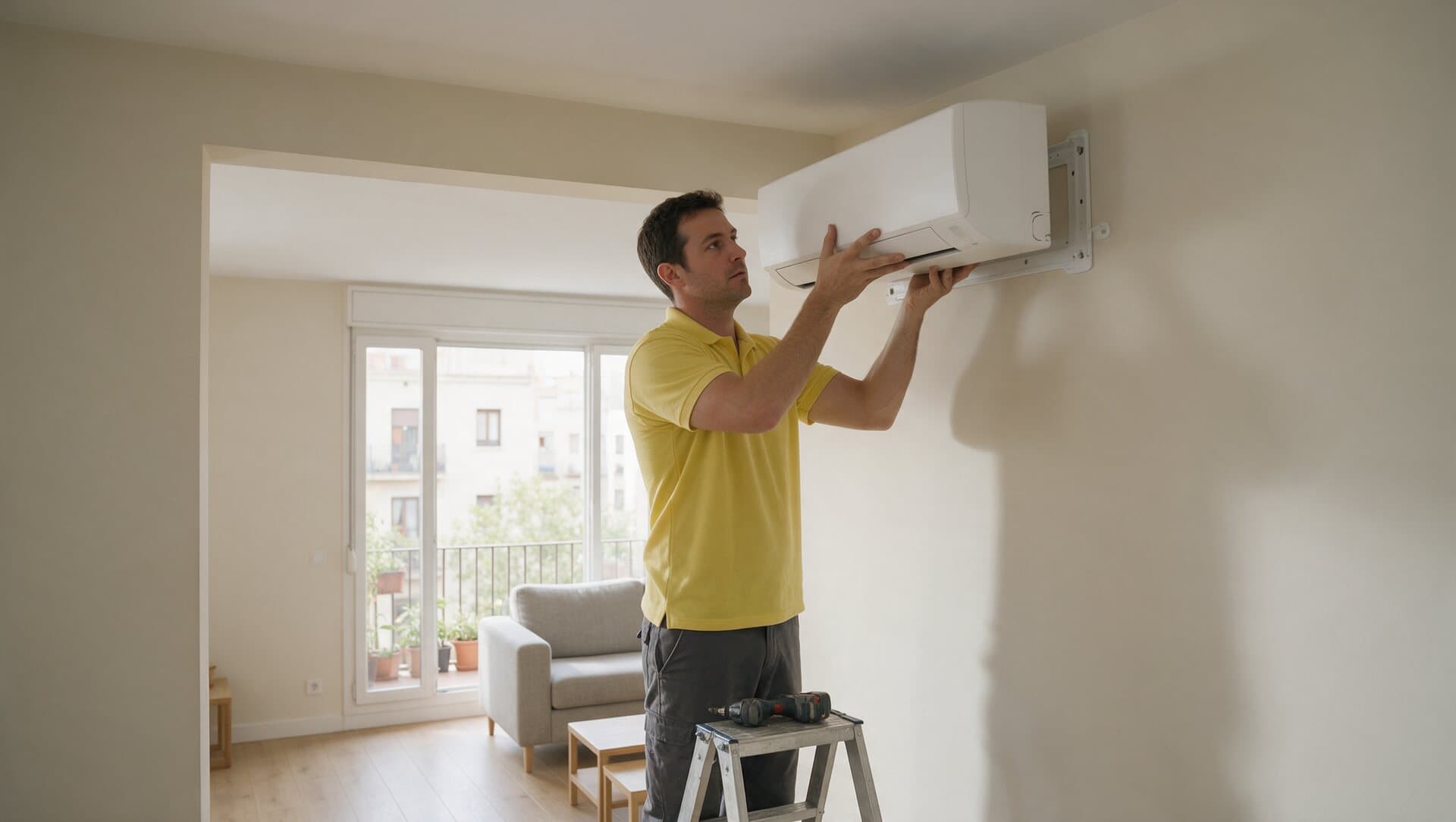
In most older Barcelona flats, the sensible choice is a 1x1 split if you want to air-condition one or two rooms, or a multi-split if you need three and have little space for outdoor units. Ducted systems give the most discreet result, but they mean lowering the ceiling and only pay off if you’re renovating anyway. Installing a split starts at €300* (unit not included), a 2x1 multi-split at €600* and a 3x1 at €900*. Before you choose a system, though, what really decides things is where the outdoor unit can go.
Three systems, three kinds of flat
All three systems cool and heat using a heat pump; what changes is how the air is distributed and how much building work each one needs.
- 1x1 split: one wall-mounted indoor unit connected to one outdoor unit. It’s the simplest and quickest option to install, and each unit works independently. It suits the main bedroom or the living room of a flat in Gràcia or Sants.
- Multi-split: a single outdoor unit serves two or three indoor units. It saves space in the light well or on the terrace, which in older buildings is usually the sticking point. The downside is that if the outdoor unit fails, every room loses its cooling and heating, and depending on the model it may run less efficiently when only one indoor unit is on.
- Ducted: a unit hidden in a false ceiling, usually in the hallway or bathroom, sends air through grilles into each room. Nothing shows on the walls, but the ceiling has to be lowered by several centimetres, which means plasterwork.
Installation prices in Barcelona
| Installation | Guide price |
|---|---|
| 1x1 split (standard installation) | from €300* |
| 2x1 multi-split | from €600* |
| 3x1 multi-split | from €900* |
| Ducted system | quoted per project* |
| Annual servicing, indoor unit | from €85* |
| Annual servicing, indoor and outdoor | from €130* |
*Guide labour prices; the unit itself isn’t included in the installation. Ducted systems are quoted once we’ve measured the flat, because the price depends on the duct route, the number of grilles and the false ceiling. We confirm the exact figure in writing before we start.
What makes installation harder in an older building
A flat from the early twentieth century in Eixample or Sant Antoni has its advantages, such as high ceilings, but also obstacles worth knowing about before you ask for a quote:
- Thick walls. Solid brick or stone walls need core drilling to get the refrigerant lines through. It’s perfectly doable, but the route has to be planned carefully.
- Ceilings you want to keep. Plaster cornices, ceiling roses or Catalan vaulted ceilings rule out ducts in those rooms; there, a well-placed split is much kinder to the ceiling.
- Old wiring. Many flats need a dedicated circuit for the air conditioning and, sometimes, a review of the power contracted with your electricity supplier. Any new circuit must be installed by an authorised electrician.
- Condensate drainage. The water the unit produces has to go into a drain, not onto the pavement or into the neighbour’s courtyard. Some flats need a small condensate pump.
- Distances. The further the outdoor unit is from the indoor ones, the longer the lines and the more the installation costs.
Where the outdoor unit can go
In Barcelona, this is the decision that shapes everything else. The city’s urban landscape rules restrict where air conditioning units can be placed on street-facing façades, and in listed buildings the conditions can be stricter still. That’s why the usual approach is to look for another location:
- A light well or the inner courtyard of the block, on brackets fixed to the wall.
- A terrace or enclosed gallery, ideally out of sight from the street.
- The building’s roof, if the owners’ association allows it and the pipe run is reasonable.
The façade, shared courtyards and the roof are communal elements, so you’ll need the owners’ association on board; noise from the outdoor unit is also the neighbours’ business. If the installation affects the façade or the roof, it may also require a notification or a municipal permit. Check with the building administrator and, if in doubt, with the Ajuntament before buying the unit; during the visit we’ll tell you which locations we think are workable.
How to choose: a simple rule of thumb
- One or two rooms and space for two outdoor units: separate splits. If one fails, the other keeps working.
- Three rooms and only one spot for an outdoor unit: a 3x1 multi-split.
- A full renovation under way and high ceilings: ducted is worth looking at, because the false ceiling is already part of the job.
- A rented flat, or no building work planned: a split, which is usually installed in a day and doesn’t touch the ceilings.
When it comes to capacity, don’t trust generic per-square-metre tables. A west-facing top-floor flat in Sant Martí doesn’t need the same as a lower-floor entresuelo in Sarrià-Sant Gervasi. We work it out with you based on orientation, insulation, ceiling height and how you’ll use the room.
Maintenance: what you can do yourself and what you can’t
Cleaning the indoor unit’s filters every few weeks during the season is your job, and it shows in both running costs and air quality. The annual service, with a thorough clean of the indoor unit and a check of the outdoor unit, the drains and overall operation, starts at €85* per indoor unit, or €130* including the outdoor unit. Only technicians certified for fluorinated gases may handle the refrigerant, so insist on that certification from whoever installs or services your unit.
If you have an older flat and aren’t sure which system suits it, tell us how many rooms you want to air-condition and send photos of the light well, terrace or gallery where the outdoor unit could go. We’ll reply within 24 hours on working days, come and measure up and send you a written quote, with the installation and, if you want it, the unit itself as separate items.
Frequently asked questions
Questions on this topic
In Barcelona, the urban landscape rules restrict air conditioning units that are visible on street-facing façades, so it’s generally not advisable. Check with the owners’ association and the Ajuntament (city council); the usual options are a light well, an inner terrace or the roof.
Two splits are independent: if one breaks down, the other keeps working. A multi-split takes up less space outside, and in older buildings that space is usually what decides it.
It can, but it means lowering the ceiling in the hallway or bathroom and doing plaster and paint work. If no building work is planned, a split or multi-split is usually the more sensible choice.
No. Prices from €300* are for a standard installation. We can source the unit for you, or fit one you’ve already bought; either way, the quote lists the unit and the installation as separate items.
A service costs from €85* for each indoor split; if we check the outdoor machine as well, from €130*. Between services, clean the filters yourself every few weeks during the months you use it.